
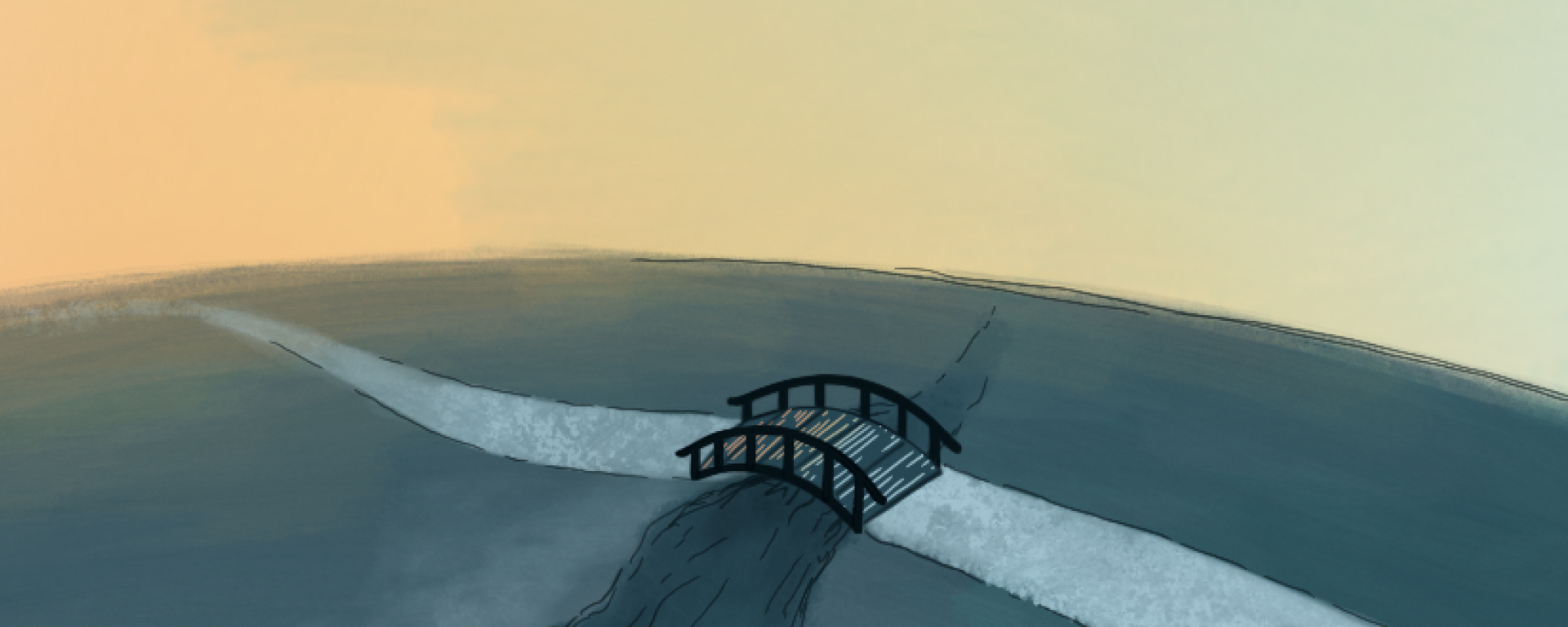
by Kateryna Maksyutynska
Graphic design Jayne Leggatt
As a graduate student, I have the opportunity to work on various clinical trials that allow me to interact with diverse patient populations. These experiences encourage me to reflect on the unique nature of each participant’s story. Particularly, working with young adult and adolescent patients has emphasized the transformative power of diagnosis and its impact on the trajectory of one’s life. This motivated me to further understand the patient experience from various perspectives. This is exactly what drew me to Suleika Jaouad’s memoir Between Two Kingdoms: A Memoir of Life Interrupted, which offered me a glimpse into her exceptional story.
Jaouad’s memoir takes readers through her inspiring and unpredictable journey transitioning from diagnosis to remission while battling acute myeloid leukemia. It captures the intricacies of guilt, uncertainty, and self-discovery through Jaouad’s retelling of her experiences. The narrative incorporates recurring contrasting themes and highlights the fine line separating love and loss, sickness and health, and denial and acceptance, as Jaouad teeters between these “kingdoms” throughout her life. Having the opportunity to read this memoir at the same age as the beginning of Jaouad’s story helped me to understand her mindset during this time; appreciating the hope she felt for the future as a young adult, but riddled with uncertainty amplified by her diagnosis. This lends to the power of this memoir, such that Jaouad’s vulnerability invites readers to reflect on the physical and mental resilience of humans, supported by modern medicine, that defies the odds.
A remarkable and moving element of this memoir was the message that recovery is not always synonymous with restoration; returning “back to normal” does not equate to living the same life as before. Instead, recovery involves appreciating and accepting the changes and learning to adapt to them. Jaouad openly grapples with this notion throughout her journey, and best summarizes it in the following quote:
Recovery isn’t a gentle self-care spree that restores you to a pre-illness state. Though the word may suggest otherwise, recovery is not about salvaging the old at all. It’s about accepting that you must forsake a familiar self forever, in favor of one that is being newly born. It is an act of brute, terrifying discovery.
A key factor that contributes to this re-birth is the relationships that are either newly developed or strengthened throughout the process of recovery. In this memoir, Jaouad sought solace in her connections with others to escape her reality, while also seeking comfort in the unspoken understanding she shared with those who reflected her own journey. The power of social supports is of note, as they have been associated with better general health and quality of life in cancer patients, emphasizing the importance of their role during recovery.1 This is evident through the family and friends that were introduced to readers in the memoir.
Overall, this inspiring memoir is an ode to the non-linear path to recovery, often leaving “life interrupted.” It candidly touches on themes to which all readers can relate by masterfully outlining the darkest, but also highlighting the most beautiful elements of life. To those hoping to appreciate the meaning of resilience, vulnerability, and growth, this book is for you. Just remember to grab some tissues as Jaouad’s memoir will have you shedding tears of both joy and sorrow.
 IMS Magazine