
By Janet Z. Li
Graphic design Brendan Lazar
The Organization for Human Brain Mapping (OHBM) celebrated 29 years of scientific meetings in imaging this year in Montréal, Québec. This international organization is dedicated to advancing the understanding of the anatomical and functional organization of the human brain using various modes of neuroimaging.1 Some methods of focus are magnetic resonance imaging (MRI), functional MRI, position emission tomography (PET), electroencephalogram (EEG), magnetoencephalography (MEG), electrophysiology, preclinical imaging, and genetics.
On our first conference day in Montréal, my lab mates and I attended various educational courses designed to delve deep into niche topics of interest. I sat in on the morning course titled “Advanced methods for cleaning up fMRI time-series” and the afternoon course “Why it all comes back to Anatomy”. The evening Talairach Lecture was a very technical overview of developmental critical periods and Alzheimer’s Disease and was succeeded by a grandiose welcome reception at Old Port.
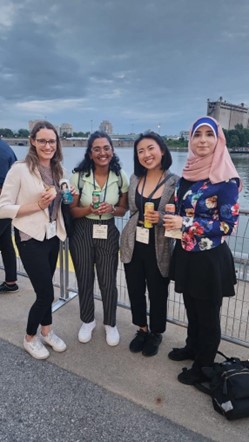
The following four days were packed with back-to-back seminars and talks on a multitude of topics. Being from a pain neuroimaging lab, and with my personal research being on conditioned pain modulation and descending antinociceptive pathway fMRI strength, I attended various sessions that focused on brain mapping, fMRI technical advancements, and connectome connectivity. A highlight keynote was from Dr. Emily Jacobs who spoke about gonadal hormones as powerful neuromodulators of learning and memory.
In addition to presentations, OHBM also hosted several discussion panels and roundtable events where experts shared their personal advice on subjects such as life after grad school, how to acquire funding, and data sharing. My personal favorite symposia was a morning talk titled “Addressing the challenges of Global Brain Health and Diversity through Neuroimaging.” This session heavily showcased longitudinal research, which is more difficult to find in the field of neuroscience, so it was an interesting opportunity to hear about the extended work being done across the world.
Despite having a tight schedule, I was able to spend a bit of time exploring the city of Montréal between sessions and in the late evenings. Our lab attended two evening events which brought us to Old Port and St Henri area, respectively. During both of these excursions we took advantage of the local food and basked in the European-inspired vibrancy of the community. After sunset, the streets became alive with music and laughter and the Grande Roue shined brightly. I also took a quick tour around Chinatown and even biked along the Pont Concorde on my way to visit Parc Jean-Drapeau where the Biosphere and famous F1 racetrack are located.
Besides sight-seeing, we got to try some stunning restaurants and cafés. Notable mentions go to La Finca café, Chifa, and Mlle Catherine for some of the best ice-cream I have ever had.
I know I speak for many of us when I say that we are extremely grateful to have had the opportunity to attend OHBM in Montréal this year. We left feeling thoughtful and inspired – ready to push forward in our own neuroimaging research.
 IMS Magazine
You must be logged in to post a comment.