
by Iciar Iturmendi-Sabater
Graphic design by Brendan Lazar
“I believe research does not take place in a vacuum; I can’t ignore the climate and biodiversity crises unfolding around me”, shares Carly Davenport, a master’s student at the Institute of Medical Science (IMS) and the co-founder of BirdsafeUofT. She researches the resting-state functional connectivity in people with neurodegenerative syndromes under the supervision of Prof. Carmela Tartaglia in the Tanz Centre for Research on Neurodegenerative Disease. We meet over Zoom and in less than five minutes she creates a safe environment where tips on how to learn functional neuroimaging from scratch are shared and the salience network is discussed, an intrinsically connected network of cortical and subcortical brain structures. “Reduced functional connectivity in this network is associated with clinical symptoms of neurodegenerative syndromes, like loss of empathy or reduced socioemotional sensitivity”, Carly explains. Her research is meaningful to both patients and caregivers, since symptoms of impaired social cognition in patients with dementia frequently relate to burden and depression amongst caregivers as well.
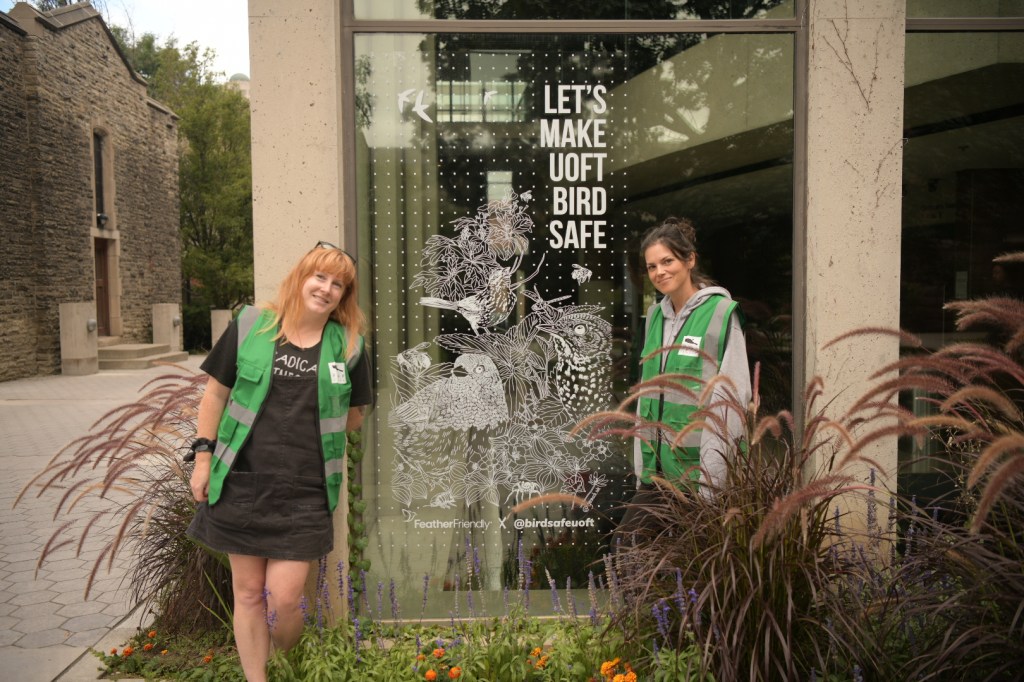
Photo shared by Carly Davenport
Just as passionately as Carly talks about her master’s research, she strongly advocates for preventing bird-window collisions at the University of Toronto (UofT)’s St. George campus. One wonders if Carly’s artistic side had anything to do with designing the illustrations seen in some of UofT’s windows aimed at preventing these collisions. She studied drawing and painting at OCAD and worked as an Assistant Art Director in the film and television industry for over a decade before embarking on a second career in science and starting her postgraduate studies at the IMS. Humbly, Carly answers she wishes she had the time and ability to design these illustrations herself. Her friend, artist and BirdsafeUofT co-founder Laurna Germscheid deserves all the credit, while Carly contributes from an art direction angle. In the Fall of 2023 only, they completed window retrofits at Victoria University, New College, and the Ramsay Wright building. This work is just the cherry topping of the efforts they make to ensure UofT is a bird-safe campus. As it turns out, Carly has indeed found the time to complement her postgraduate research with meaningful environmental action.
“Because of the green spaces on campus, there’s a lot of birds that trickle up from the waterfront, forage, and spend some time on campus before moving on with their migration”. Combined with the unsustainable architecture on campus, this leads to a lot of fatal collisions happening here. After taking a 4-year ornithology course during her undergraduate degree, Carly joined Canada’s Fatal Light Awareness Program (FLAP, flap.org), the principal charity in Canada with the goal of preventing the over 25 million bird-building collisions that happen every year in our country. FLAP has a bird-safe campus programme which Carly has brought to UofT. They collect data for the Global Bird Collision Mapper (birdmapper.org), where over 90,000 collisions have been reported so far. They also rescue and rehabilitate birds injured in window collisions, advocate for improved policy and guidelines, and organize education and outreach events.
Right now, a lot of buildings on campus have a mirrored quality to the glass. “They’re treated on the inside, which is an obstacle that I keep running up against over and over. You must disrupt the outside, the first surface, if you want to disrupt the reflection”. Unfortunately, there is no legislation in Toronto, Ontario, or Canada to mandate treating windows with bird-deterrent markings yet. Although Carly explains that “FLAP is advocating for the adoption of the CSA A460:19 bird safety guidelines into the Ontario Building code, so perhaps soon”. New York, for instance, does have it. What we have in Toronto is the green standard. However, since it has gone through a number of different iterations and considering how early site plan applications are submitted before construction starts, architects often comply with outdated versions. “This is very frustrating for me. I see UofT spend thousands of dollars on glass that is treated on the interior, like for example Robarts Common by Diamond and Schmitt Architects. The bird-deterrent pattern needs to be the exterior surface to break up the reflective property of glass. It also needs to be 2” x 2” spacing, Robarts is 4” x 4”—this does nothing for hummingbirds that collide or some of the smaller warblers”, says Carly. She explains that BirdsafeUofT is “working with UofT’s Sustainability Office to hopefully adopt the Canadian standard for bird friendly windows into the university’s design standards, which are currently being revised”.
If you see a dead or injured bird at the base of a building on campus, you can email birdsafeuoft@gmail.com or DM @birdsafeuoft on Instagram with a photo and some information about the bird and collision. Anyone can also log in to the Global Collision Mapper and map their own observations. Carly reminds us that “it is illegal to harass, possess or transport a migratory bird in North America without a permit”. You need to be a FLAP volunteer to be covered by their scientific permit.
“I’m a FLAP volunteer. My friend, Laurna, the talented artist, she’s a FLAP volunteer. We both are on campus here and there. So we thought, there’s no one actively patrolling campus right now. There are a lot of glass buildings. Let’s patrol it and see what we find.” In this way, Carly transformed her daily walks to campus into patrolling outings. She and Laurna then thought: “Here’s a university that has a School of the Environment. They have a big Ecology and Evolutionary Biology program. They have an Architectural Studies program. This will be a slam dunk, we’ll get the campus treated”. Although change is achieved slowly, Carly is already setting an example of collaboration across different schools at UofT. She shows resilience in her belief that the social and environmental context where our research takes place matters, and we have the responsibility to take action.
 IMS Magazine
You must be logged in to post a comment.