

by Sonika Kumari
Graphic design by Jeah Kim
As graduate students, we are typically bound to the established education curriculum, but Nairy Khodabakhshian’s decision to reshape the curriculum has opened doors for innovation. Nairy is a PhD student in the Institute of Medical Science (IMS) studying the cardiac response to exercise in pediatric patients, working under the supervision of Dr. Luc Mertens at The Hospital for Sick Children. While working on a clinical project during the early days of graduate school, she quickly realized she was not yet equipped to appropriately handle clinical situations. Nairy explains that she was “working with pediatric patients facing life-altering diagnoses and could not find any resources focusing on patient-facing communication skills”. This made it difficult to learn how to have tough conversations with patients, or to give support in emotional situations. In the intricate realm of clinical research, pivotal elements like confidentiality, consent, and the meticulous handling of sensitive data stand as pillars of ethical practice. Surprisingly, graduate students often find themselves navigating these waters without formal training, highlighting a critical gap in their education.
Nairy wondered if other students were dealing with similar situations in their clinical research, and by surveying students across IMS, she identified this as a gap in graduate education. This led her to the idea of designing a course specific to helping research students with clinical skills, which she pitched to the IMS Curriculum Committee. A key innovation in her pitch was the use of virtual reality (VR) to expose students to clinical settings in a safe and controlled manner. Upon receiving their approval, Nairy spearheaded the course design process in 2021, working closely with Nicole Harnett and Sobiga Vyravanathan. Nairy played a central role in coordinating meetings, liaising with faculty members, and conducting research for the project.
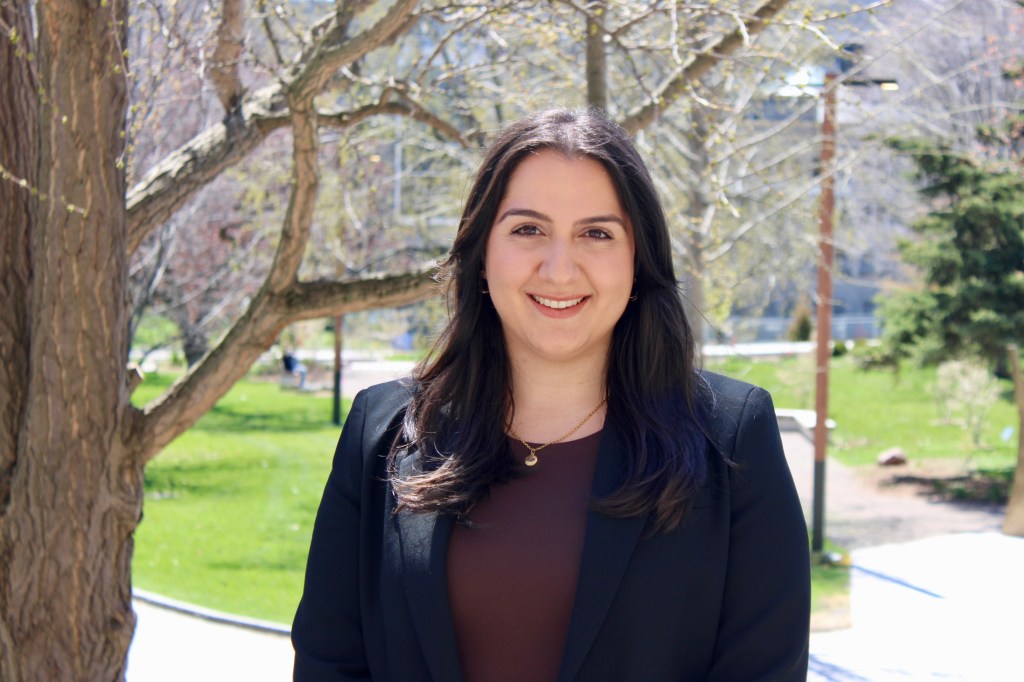
Photo credit: Niki Akbarian
Nairy assembled a team of fellow graduate students, including Kyla Lee, Maryam Sorkhou, and Tulip Marawi, who provided invaluable assistance in shaping the course syllabus, assignments, and design. Working with faculty, Nairy also recruited Jessica Feng, a Biomedical Communications student, who undertook the VR development as her Master’s project. Collaboratively, they documented the course creation process, conducted a comprehensive review, and applied for grants to support their initiative. The team’s efforts were recently recognized with the Graduate Education Innovation Fund (GEIF) award, which will be used to develop a module focusing on Indigenous health.
The Clinical Research Skills course (MSC 1121) is divided into three sections, with two weeks dedicated to each section: plain language communication, research ethics, and professionalism. The first two weeks will be focused on learning about patient-centered language, recruitment material, and consent documentation. Weeks three and four will teach students about ethics specific to clinical research projects and students will have a chance to get the perspective of being a research ethics board reviewer for their peer’s studies. Lastly, weeks five and six will focus on professionalism and role playing through the use of VR. In the latter, students will complete virtual clinical scenarios that involve navigating ethical dilemmas, obtaining informed consent, and incorporating Indigenous ways of knowing into clinical research. Nairy suggests that VR presents a promising avenue for alleviating strain on the healthcare system because students can receive clinical exposure without having to shadow healthcare professionals. Moreover, it offers financial efficiency, as utilizing standardized patients for traditional clinical training can be costly and VR scenarios can be repeated infinite times.
As Nairy reflects on her journey, she says, “the IMS and its faculty really believe in innovation and novelty in graduate education” and provide students with the resources to make their idea come to life. She has acquired a multitude of skills. These include the critical significance of crafting course objectives, the art of curriculum development, adept task delegation, effective time management, proficient project management, and seamless communication with faculty members, among others. She hopes to stay involved with the course and is excited to see how it develops. Nairy says she has “endless ideas for future courses and this course design process has made [her] fall in love with academia”. She is beyond “grateful to have had this privilege of designing a course as a graduate student and has now found a passion for [her] future”. Overall, the support provided by IMS along with Nairy’s creativity and hard work has enriched the education curriculum for future IMS students.
References
Khodabakhshian, N., Gaeul Lee, K., Marawi, T., Sorkhou, M., Vyravanathan, S., & Harnett, N. (2024). Virtual Reality for Developing Patient-Facing Communication Skills in Medical and Graduate Education: Protocol for a Scoping Review. JMIR research protocols, 13, e53901. https://doi.org/10.2196/53901
 IMS Magazine
You must be logged in to post a comment.