
by Kristen Ashworth
Graphic design by Emily Huang
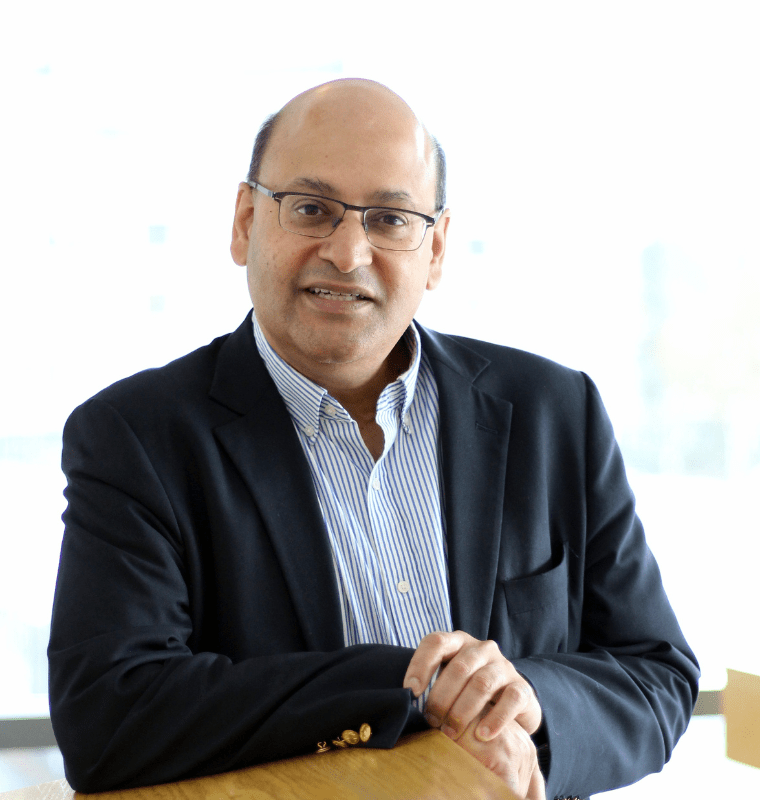
“Don’t forget where you came from, and pay it forward.” This guiding principle has helped to shape Dr. Tony George’s career, from his roots in small-town Nova Scotia, to his current position as a leading scientist in psychiatric research at The Centre for Addiction and Mental Health (CAMH). He attributes the meaningful connections he has built throughout his life in paving his professional (and personal) success, and now places a strong emphasis on mentoring the next generation of scientists.
Provided by Dr. George
Dr. George is a psychiatrist and senior scientist at CAMH, and professor at the Department of Psychiatry at the University of Toronto. He completed his medical training at Dalhousie University, followed by a psychiatry residency and fellowship in Translational Neuroscience at Yale School of Medicine. After pursuing a near-decade-long position as a physician-scientist at Yale where he established his first laboratory, Dr. George came back to Canada, joining the University of Toronto as a faculty member in 2007. His lab at CAMH, called BACDRL–the Biobehavioural Addictions & Concurrent Disorders Research Laboratory – is focused on investigating the mechanistic relationships between drugs of abuse, such as nicotine and cannabis, and the psychiatric disorders with which they are associated, such as schizophrenia and depression.
Dr. George is now a leading psychiatrist and scientist in the field of behavioural addiction research, but his path into psychiatry was not a linear one. He grew up in Kentville, Nova Scotia–a town with a population of less than 6000. His parents, who had immigrated to Canada from India, supported and encouraged him to aim high academically. His father, a psychiatrist himself, helped to provide Dr. George with an understanding of the field of medicine from a young age. After high school, Dr. George moved to Halifax to attend Dalhousie University, first to complete his Bachelor of Science, and then, his medical training.
Upon entering medical school, he was still unsure of the field of medicine about which he was most passionate. At the time, he was working in a laboratory studying metabolic organization of lipid pathways–a field outside the realm of psychiatry. But, it was through the experience at this lab that his passion for scientific research was first sparked. By the end of his medical school education, Dr. George had become deeply interested in the workings of the brain, and decided psychiatry would be the right path for him. To combine both passions–scientific research, honed from his lab experience, and psychiatry– he chose Yale to complete his clinical residency and fellowship in Translational Neuroscience. There, he was mentored by Dr. Robert Roth and conducted research on the effects of drugs, like nicotine, on the brain dopamine function in rats.
He reflects on his time with Dr. Roth as a pivotal experience in his research career, because it launched him into a whole new network of scientists that enabled his growth at Yale and further, to this day. In a full-circle moment, he reflects on the serendipity of one of his first publications from Dr. Roth’s lab: a paper published in Neuropsychopharmacology, the very journal where he now serves as co-principal editor.
Dr. George explained how he transitioned from rat research with Dr. Roth, to clinical research at Yale, first by developing a rat model that could be translated to humans to study the effects of nicotine on working memory. As a psychiatrist, he found that working with a human-translational model resonated deeply, bringing his work closer to the clinic. He was able to garner significant funding for this research, and was able to carve his own path in an increasingly competitive field at the time. “It was called the decade of the brain,” Dr. George explains, recalling the 1990s, when neuroscience and psychiatry were at the forefront of scientific advancement.
In conjunction with this research while a faculty member at Yale, Dr. George established a translational research program called the Program for Research in Smokers with Mental Illness (PRISM). Dr. George explains how PRISM helped segue his research at his current lab, BACDRL, when he moved back to Canada and started his position at the University of Toronto and CAMH in 2007: “[PRISM was] my first attempt to study addictions in people with serious mental illness, and focused on tobacco. It morphed into the BACDRL program at CAMH when I came to Toronto, which now studies a broader range of addictions (cannabis, nicotine, alcohol) and co-occurring mental illness (schizophrenia, mood and anxiety disorders).”
Outside of the BACDRL lab, Dr. George has made a significant impact as a member of the Institute of Medical Science (IMS). The graduate-level IMS course that he has developed, called The Biopsychosocial Basis of Mental Health and Addictive Disorders (MSC1089), covers the complex intersections of behavior, addiction, and mental illness. Throughout the course, Dr. George brings in a diverse group of colleagues and guest speakers who offer perspectives on several topics of behaviour and addiction–including aspects of genetics, pathophysiology, clinical phenomenology and diagnostics, and treatment. In 2021, he was awarded an IMS Course Director Award in recognition of his excellence in teaching, and the impact MSC1089 has made in the IMS course portfolio, with its highly relevant and engaging content on mental health and addiction.
Reflecting on what he enjoys most about being a part of UofT and IMS, Dr. George says, “UofT and IMS offer a diverse and dynamic research environment, and access to a large number of excellent graduate students which is unmatched at other centers, including at Yale. It is a collegial and collaborative place, whether mentoring my own grad students or teaching my course in IMS.”
As a trailblazer in the field, Dr. George credits his parents, his wife, and his daughter, as key sources of inspiration and support in helping him reach where he is today. In addition, he emphasizes the role his mentors have played along the way throughout medical school, residency, and fellowship as he sought to establish himself as a physician-scientist. Now, he explains, he is committed to “paying it forward” by sustaining a meaningful, mentoring presence for his own students– whether they are graduate students in his lab, medical students and residents shadowing him through rotations at CAMH, or his course students who take a vested interest in the material. He believes that having a mentor that cares deeply about your success is critical, and advises IMS students to seek out mentors who can propel them to new and exciting opportunities in academia and beyond.
Dr. George’s journey illustrates that true success–whether in science, medicine, or any other aspect of life– is achieved not only through hard work and determination, but also by the people in your life that support you in getting there. And, by coming together to nurture the next generation of scientists, he is confident that the future of addiction research will be left in capable hands.
 IMS Magazine
You must be logged in to post a comment.