

by Beatrice Acheson
Graphic design by Jeah Kim
“I would work in the lab for free. It’s that love for it that keeps me going. Sometimes [when experiments don’t work] I think ‘well that sucked,’ but I know I’ll be back tomorrow.”
These words capture the dedication of Alex Boshart, a fifth-year PhD candidate at the Institute of Medical Science (IMS) investigating the role of antibody-mediated rejection (ABMR) in kidney transplant failure. Under the supervision of Dr. Ana Konvalinka at Toronto General Hospital, Alex conducts research aimed at improving outcomes for kidney transplant patients. His impact is not confined to the lab, Alex takes on many roles in the IMS precinct. As the Senior Advisor for the IMS Student Association (IMSSA) and Prospective Student Ambassador for IMS, he dedicates his time to helping new students and enhancing their academic experience.
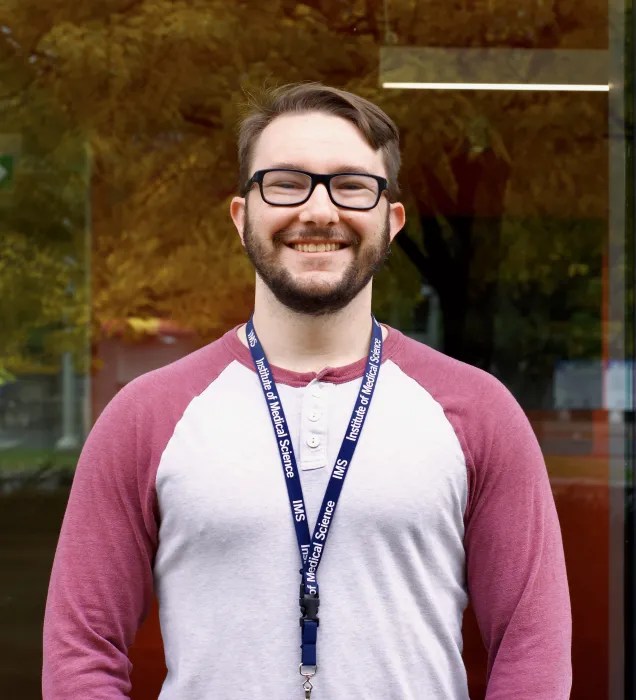
PhD Candidate, IMSSA Senior Advisor, and IMS Prospective Student Ambassador
Provided by Alex Boshart
When we sat down for coffee in the sleek lobby of the MaRS Centre, I asked him to tell me a bit about what he does. Before I knew it, he was describing the intricacies of ABMR, the leading cause of allograft failure five years after transplant and emphasizing the dire need for new therapies to improve patient outcomes following kidney transplants. His passion for all facets of his research, from the underlying science to its clinical applications, was immediately apparent.
But Alex was not always so certain of his path. After completing his undergraduate degree in Health Sciences at Wilfrid Laurier University in 2019, he had to delay his IMS start date from September 2019 to January 2020.
“[After graduating university] I didn’t get into medical school. I was like, ‘Okay, what’s next?’ I took the summer to figure that out, which is why I started in January. I couldn’t collect everything in time for September,” Alex said.
The process was daunting and intimidating, and Alex recalled the questions that plagued him: “What happens if I don’t find [a supervisor]? Can I still come [in January]? How does this work?”
After a few anxious calls to the IMS admissions office, Alex connected with Dr. Konvalinka, who invited him to complete a placement in her laboratory that fall, allowing both parties to decide if it was the right fit. “I was lucky that I found Dr. Konvalinka, and that she was willing to take a chance on a kid that had never done cell work,” Alex said, attributing his success in securing the role to his keen attitude and commitment to learning. “[I told her] that I am a quick learner. I am interested and I am willing.” Alex suggests to new and current IMS students that this mentality is “all you need because you are here to learn anyways.”
Despite finding his footing in the Konvalinka lab, Alex stressed that obstacles continued to arise in his PhD, and they still sometimes do. He learned adaptability and resilience early on in his graduate career. In 2020, during his first Program Advisory Committee (PAC) meeting, Alex received a dreaded question: “‘What if [your experiments] don’t work? How will you pivot?’” Alex was initially caught off guard, stating, “I wanted to cry. I didn’t know what I would do if it didn’t work.”
However, Alex bounced back quickly, gaining confidence in his identity as a researcher after returning to the lab in person following the COVID-19 pandemic. “Only after the first year, once I got back to the lab after COVID-19, did I hit my stride. I told myself, ‘I’m doing science. I am a scientist,’” Alex said.
In taking his research by storm, Alex obtained vast and diverse technical skills, but he stresses that, most importantly, he has learned the importance of resolve, determination, and curiosity to succeed in graduate studies. “I like to say that the P in PhD stands for problem-solving,” he noted. “You aren’t just learning how to learn, but also how to roll with the punches. If one door doesn’t work, how do you open the window? How do you pick the lock?”
Alex suggests that creative problem-solving is key to success in graduate studies, and he wasn’t kidding when he said to “roll with the punches.” In his free time, he enjoys watching mixed martial arts (MMA) with his friends. He added that his time watching the sport has taught him valuable lessons and drew a parallel to the inevitable setbacks of research: “You get hit, but you keep moving because this is our sport, and this is what we like to do.”
Alex’s academic journey is a testament to perseverance and has inspired him to assist other new IMS students in their journey to graduate school. As the Prospective Student Ambassador for IMS, Alex is responsible for calming the inevitable nerves of incoming IMS students.
“We answer questions. But the questions are never tough ones, they’re more like, ‘Am I going to be okay?’ and ‘I’m really worried about this,’” Alex explained. He hopes to provide incoming students with answers to the questions that he himself had nearly five years ago.
Alex stresses that his work would not be possible without support, emphasizing the importance of his friendship and collaboration with Co-Prospective Student Ambassador Sajeevan Sujanthan, a fourth-year PhD candidate at IMS. “He and I fill each other’s niches because I work in a wet lab, and he works in a dry lab. When we have [new students] come in, they can get both perspectives. We can delegate based on our areas of expertise,” Alex said. “We are really close. There’s no one else I’d want to work in this position with. We work very well together.”
Alex maintains this collaborative attitude in the lab as well, crediting much of his success as a researcher to the teamwork in the Konvalinka Lab. “We’re a very collaborative lab. We all do everything for each other. The synergy is amazing. We all discuss results because maybe in your thought process, you’re missing something that someone else will see. It adds another layer,” he highlighted.
Alex’s holistic commitment to IMS through research, advocacy, and leadership, has not gone unrecognized. In 2024, Alex was awarded the Roncari Prize, which acknowledges IMS students who have made significant contributions to the academic experience of other graduate students.
Throughout our conversation, Alex’s message remained strong: be fearless, take advantage of what is in front of you, and have fun while you do it. As an incoming student myself, I left the interview inspired and motivated to begin my graduate journey in IMS, but I was struck mostly by Alex’s commitment to humility in his work despite his significant accomplishments.
“When you’re green, you grow and when you’re ripe, you rot,” Alex mentioned. “Everyone wants to be at the peak, but if you stay green, then there is always space to grow.”
As Alex continues his journey in IMS, his story serves as a powerful reminder of the importance of resilience, collaboration, and community. Much like in the MMA fights he enjoys watching, Alex’s approach to his research is about rolling with the punches, adapting to challenges, and staying in the fight no matter what. With unyielding curiosity and humility, Alex is not only advancing the field of kidney transplant research but also inspiring the next generation of scientists to approach their work with passion, perseverance, and the readiness to keep moving forward.
 IMS Magazine
You must be logged in to post a comment.