
by Beatrice Acheson
Graphic design by Stefanie Wang
The age of precision medicine is upon us. With the rapid rise of artificial intelligence and the accessibility of tools like whole genome sequencing, scientists are achieving feats that once seemed impossible. While these developments will no doubt revolutionize medicine, we must confront the unfortunate paradox that arises when we advance medical technology: we will cure people in ways that we did not know were possible, but we may also worsen existing inequities in ways that we cannot yet fully grasp. Kazuo Ishiguro’s Klara and the Sun explores a fictional future that explores these ethical dilemmas and offers insight into the potential consequences of advancement made at the expense of humanity.1
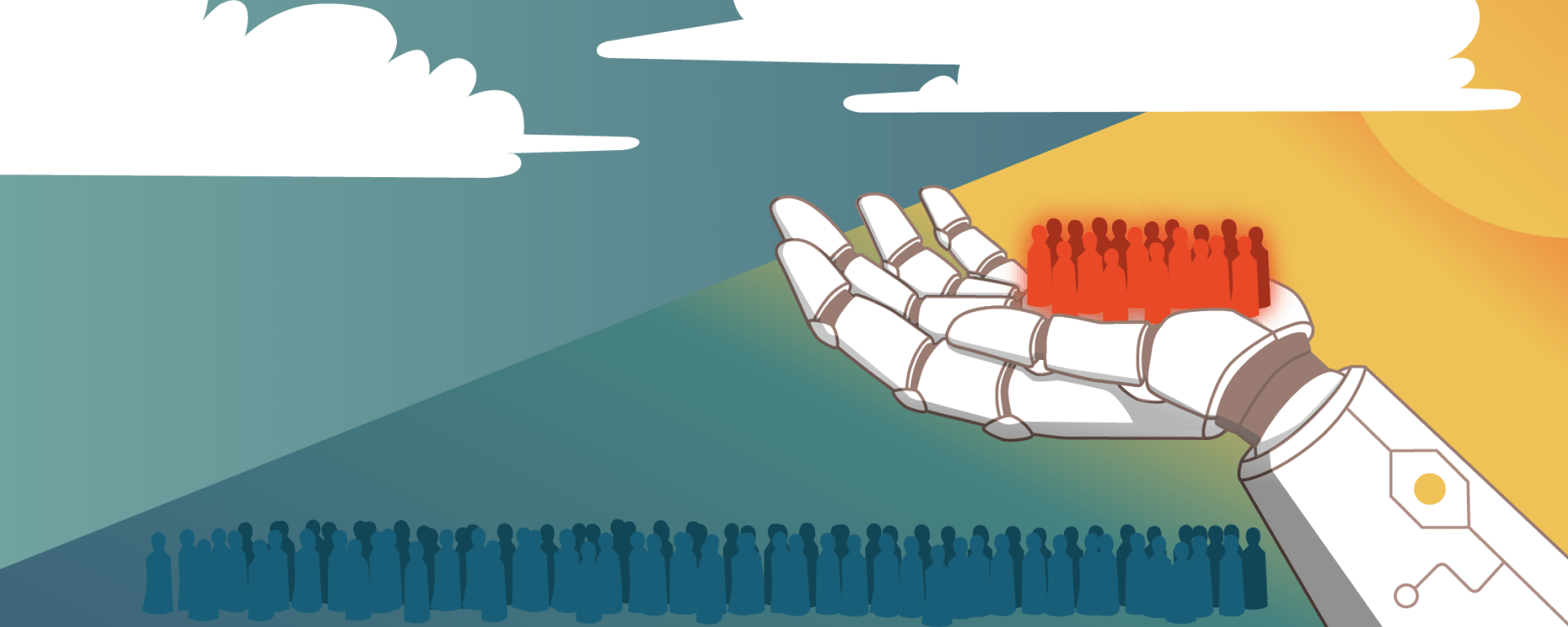
In his first novel since winning the Nobel Prize in Literature in 2017, Ishiguro depicts an eerily plausible dystopia in which children have Artificial Friends–humanoid robots powered by artificial intelligence and programmed as companions. Some children in Ishiguro’s futuristic landscape are “lifted,” having undergone genetic editing to enhance inherent attributes such as intelligence and disease susceptibility, while others have not. “Substitutions” have replaced entire job sectors with genetically enhanced individuals. Ishiguro presents a reality where the line between human and machine is blurred, compelling the reader to confront the complex relationships we have with one another, ourselves, and technology in a world in which technology is rapidly evolving.
The narrative unfolds through the perspective of Klara, an Artificial Friend waiting to be bought. Unlike other Artificial Friends, Klara is a keen observer. She is uniquely attentive to human emotion. To her delight, Klara is selected by Josie, a lifted child who is overcoming the side effects of genetic editing. Upon entering Josie’s life, Klara is confronted with the harsh realities of a society where genetic editing has become the norm; Josie’s friend, Rick, is unable to go to university because of his status as “unlifted,” and Josie’s father, a former engineer, is “substituted” despite his ability and skill. Through Klara’s perspective, Ishiguro provides a lens for readers to examine human relationships and societal dynamics. Her observations illuminate a future where precision medicine serves those with privilege but hurts those without, raising pressing ethical questions for Klara’s fictional society as well as our own.
Klara pieces together bits of information about the people around her, gradually building her understanding of the world. Klara is a nonhuman and defamiliarized narrator with a viewpoint entirely different than our own, and her perspective allows Ishiguro to emphasize the thin line that exists between human and machine, and to caution us of the implications of crossing it. In Ishiguro’s fictional world, existing class disparities are exacerbated. Through Klara’s perspective, Ishiguro challenges the reader to reflect on the social consequences of unchecked technological advances in a world in which humanity itself is redefined.
Importantly, Klara and the Sun is as hopeful as it is unsettling. As Klara works to fulfill her programmed purpose—to know and befriend Josie—Ishiguro reminds us of what makes humanity unique and why technology can never replace that. Through her experience, Klara learns that “there was something special, but it wasn’t inside Josie. It was inside of those that loved [Josie].” Klara’s insight reminds us that humanity is rooted in our ability to love, empathize, and connect. As we embrace the era of precision medicine and develop novel, individualized treatments, it is essential that we prioritize the preservation of our humanity just as stringently as we pursue technological advancements. Precision medicine will only be equitable when we commit as deeply to what unites us as we do to understanding what makes us different.
References
Ishiguro K. Klara and the Sun. Toronto: Vintage Canada; 2021.
 IMS Magazine