

by Ana Piric
Graphic design by Emily Huang
From fitness trackers, to smart watches, to fertility rings, to blood glucose monitors, the wearable device industry is ever-expanding, with a projected value of approximately $260 billion by 2030.1 While some devices have already been implemented in the medical field, such as blood glucose and electrocardiogram monitors,2 technological advancements have ushered in a new era of novel wearable devices in healthcare. However, the implementation of wearable devices in standard healthcare pose inherent challenges that must be addressed.
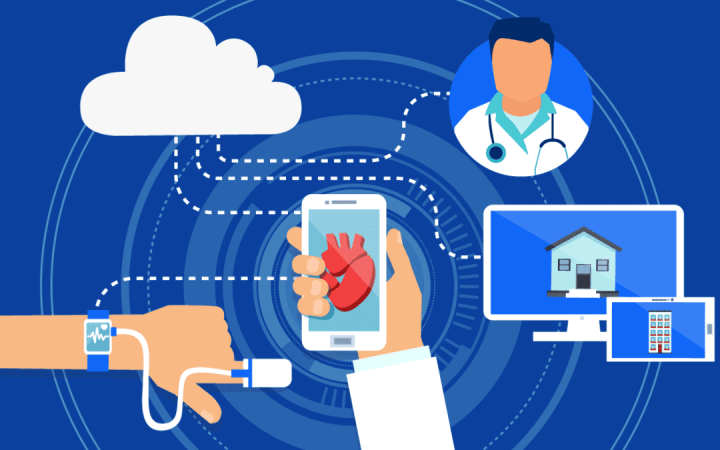
Photo Source: Choate C. The impact of Wearable Technology in Healthcare [Internet]. 2024 [cited 2024 Oct 30]. Available from: https://blog.pepid.com/2024/06/07/impact-of-wearable-technology-on-patient-monitoring-in-the-medical-field/
Wearable devices are typically worn in direct contact with a person’s skin to collect health and fitness metrics.2 Depending on the device, they can track parameters such as steps, calories, heart rate, stress levels, menstrual cycles, and sleep quality.2 The monitoring, screening, detection, and predictive capabilities of these devices can inform and empower individuals to play an active role in improving their health.2,3 Ultimately, wearables offer promise of a “more digital, personalised, and preventative medicine”.3
In addition to being used for personal health outcomes, wearables allow for improved clinical care and advancements in biomedical research.3 However, wearable devices also come with their own set of challenges that must be addressed before being integrated into standard healthcare practices.3 One of these challenges is ensuring the quality of data they produce.3 Unlike traditional medical devices, wearable devices use non-standardized methods and sensors to collect the same parameters.3 For example, oxygen saturation can be measured using watches, rings, or earphones. These varied data collection methods make it challenging to establish common standards to assess data quality.
These concerns are compounded by poor data availability across wearable devices.3 Often, researchers cannot download data directly from the device and have to search proprietary archives, which leads to a lack of information about how the data was collected, classified, and interpreted.3 A potential solution is the creation of partnerships between healthcare systems and wearable device companies to facilitate high data quality in select devices and the easy transfer of data.3
Beyond data complications, wearable devices are a double-edged sword in terms of health equity.3 The U.S. Centers for Disease Control defines health equity as the “state in which everyone has a fair and just opportunity to attain their highest level of health.”5 Wearable devices may deepen health inequities through the barriers in who can access and benefit from them, such as those with poor digital literacy and low socioeconomic status.4 As stated by Canali et al., “wearable technology seems to exclude the users that arguably would benefit the most from the use of wearables” such as the elderly and children.3 This not only exacerbates health disparities, but also leads to misrepresentation in data collection for clinical research.6 For example, in the Apple Heart Study, which aimed to detect irregular heart rhythms (atrial fibrillation) in users who opted to have their data collected, the selection bias was high, as the 400,000 participant cohort was comprised of young (more than 80% under 55 years) and white (more than 70%) participants.6 The non-representativeness of the sample led researchers to conclude that most users have a low risk of atrial fibrillation, which may not have been the case in a more diverse study.6,7 Ultimately, the rigour of Apple’s study has come into question despite being one of the largest heart studies detecting atrial fibrillation through wearable technology.7 This example highlights that to successfully adopt wearable devices in the healthcare system, a major challenge is ensuring their equitable use.
Another way wearable devices can deepen health inequities is through underdeveloped measurement methods.4 An example is the measurement of heart rate and oxygen levels in smartwatches and fitness trackers using a technology called photoplethysmography (PPG). 4,8 PPG relies on green light signalling, which is known to be inaccurate in patients with darker skin, therefore preventing researchers from obtaining accurate health data from multiple demographics.4 If these devices were to be employed by healthcare providers, their design would need to account for diverse populations prior to integration into standard healthcare practice.4
Despite the challenges of implementing specialised medical wearable devices, many are integrated into worldwide healthcare systems, such as blood glucose and electrocardiogram monitors, and more recently, wireless wearable sensor systems for vital sign monitoring in infants and pregnant individuals.4,9 Given the innate higher risk of health complications in these populations, the implementation of wearable devices will particularly benefit this vulnerable demographic.4 In the case of wireless wearable sensor systems for vital sign monitoring in infants, the injury, scarring, and disruption of skin-to-skin contact associated with wired devices is eliminated, improving neonatal recovery.4 Similarly, wireless vital sign monitoring for pregnant patients allows for remote monitoring, facilitating earlier detection of fetal health complications and quicker interventions by physicians, especially when considering geographic health inequities.4
While the advent of wearable devices, such as smartwatches and fitness trackers, conveniently inform users of their health and fitness metrics, there are issues that must be addressed to implement them as part of standard health care practices.3 These include data quality, accessibility issues, as well as navigating health equity issues arising from demographic differences and measurement methods.3 These challenges are surmountable, but necessitate effective collaboration between wearable device companies and government healthcare systems to integrate these innovative tools into our healthcare system.3
References
1.Philpott J. How are wearable patches revolutionising women’s health? [Internet]. 2024 [cited 2024 Oct 29]. Available from: https://www.medicaldevice-network.com/features/how-are-wearable-patches-revolutionising-womens-health/
2. Schroer A. 15 Examples of Wearable Technology in Healthcare and Wearable Medical Devices [Internet]. 2024 [cited 2024 Oct 29]. Available from: https://builtin.com/articles/wearable-technology-in-healthcare
3. Canali S, Schiaffonati V, Aliverti A. Challenges and recommendations for wearable devices in Digital Health: Data Quality, interoperability, health equity, fairness. PLOS Digital Health. 2022 Oct 13;1(10). doi:10.1371/journal.pdig.0000104
4. Walter JR, Xu S, Rogers JA. From lab to life: How wearable devices can improve health equity. Nature Commun. 2024 Jan 2;15(1). doi:10.1038/s41467-023-44634-9
5. What is health equity? [Internet]. 2024 [cited 2024 Oct 29]. Available from: https://www.cdc.gov/health-equity/what-is/index.html
6. Lawrence H. Was the Apple Heart Study Virtually Useless? [Internet]. 2019 [cited 2024 Oct 29]. Available from: https://practicingclinicians.com/the-exchange/was-the-apple-heart-study-virtually-useless-
7. Koetsier J. Apple Heart Study: What Stanford Medicine learned from 400,000 Apple Watch owners [Internet]. Forbes Magazine; 2019 [cited 2024 Oct 29]. Available from: https://www.forbes.com/sites/johnkoetsier/2019/03/18/apple-heart-study-what-stanford-medicine-learned-from-400000-apple-watch-owners/
8. Charlton PH, Marozas V. Wearable photoplethysmography devices. Photoplethysmography. 2023 Nov 29;44(11):401–39. doi:10.1016/b978-0-12-823374-0.00011-6
9. Kang HS, Exworthy M. Wearing the future—wearables to empower users to take greater responsibility for their health and care: Scoping review. JMIR mHealth and uHealth. 2022 Jul 13;10(7). doi:10.2196/35684
 IMS Magazine
You must be logged in to post a comment.