
By Katherine Guo
Graphic design by Anaiah Reyes
Sajeevan fondly remembers watching The Adventures of Jimmy Neutron, Boy Genius on T.V. as a child, hearing Jimmy punctuate epiphanies with his classic catchphrase—“brain blast!”
Now, years later, Sajeevan Sujanthan finds himself preoccupied with matters of the brain as a PhD candidate at the Institute of Medical Science (IMS). He is currently supervised by Dr. Richard Swartz and is studying cognitive outcomes in patients who have experienced a stroke. While Sajeevan is deeply fascinated with matters related to the brain, he remembers a time when his academic path was not so clear.
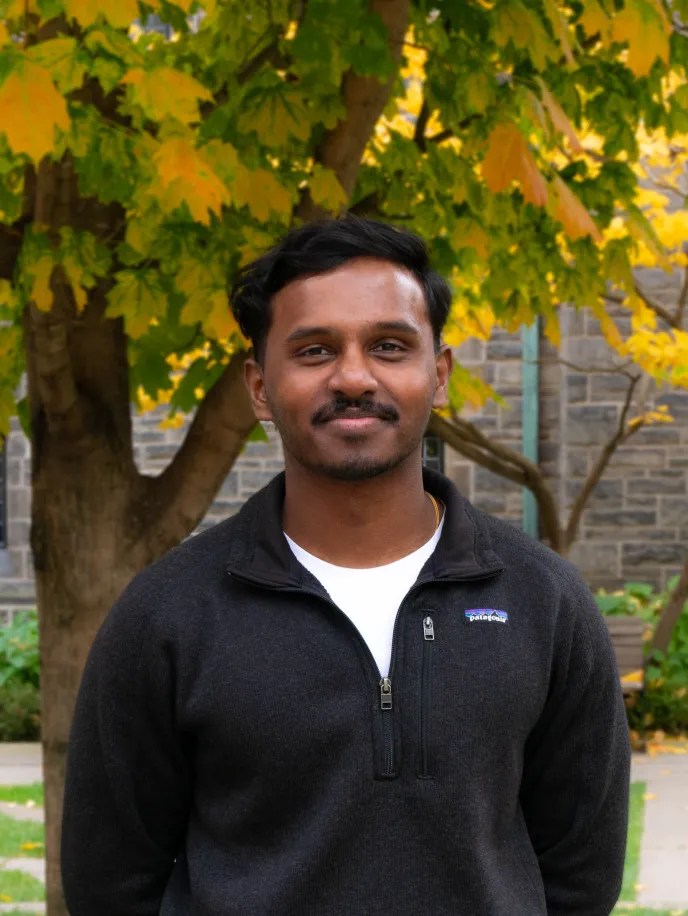
PhD Candidate at IMS
Photo credit: Katherine Guo
Sajeevan entered the University of Toronto in 2015 as an undergraduate student specializing in neuroscience. Despite the label, he didn’t pigeon-hole himself into research one might typically associate with the field, and instead spent the following summer as a research student working with black widow spiders. While working closely with these creatures is something he’d rather not repeat, Sajeevan describes it as his “first foot into research.”
The following year, the professor Sajeevan was working with suggested that he take a second-year research course under her supervision. There, he ventured into the data collection, analysis, and writing aspects of research. It was an important experience for him, as it was the one that began to spark his interest in this type of work. Sajeevan describes the independence and confidence-building associated with the experience as particularly memorable: “I could make my own questions, I could analyze my own results, and actually do things on my own.”
From there, Sajeevan parted ways with the spiders, and spent the next year in psychology research, helping PhD students with patient recruitment. Still, he remembers feeling as though there was something that wasn’t clicking—he missed being able to talk to the participants himself and making that connection.
When looking back on his undergraduate research experience, Sajeevan describes it as being “all over the place,” but he also describes how each opportunity helped him gain perspective and see what research was really like. As he went on, he became more interested in the research aspect of the work—the writing, the methodology, the problem-solving—with the subject matter being a bonus.
At this point, it is perhaps unsurprising that Sajeevan’s path took another turn. After he moved on from his position assisting PhD students, he went on to do cell-based work at Sunnybrook Hospital. It was during a summer seminar at Sunnybrook that Sajeevan was first introduced to the idea of becoming a clinician-scientist, which combined his two interests of research and patient interaction.
He started reaching out to clinician-scientists and eventually emailed Dr. Richard Swartz, a clinician-scientist at Sunnybrook Health Sciences Centre who was studying outcomes in stroke patients. Sajeevan was particularly interested in stroke, as he has distant family members who have had personal experiences with the condition.
Dr. Swartz recruited Sajeevan to work with him during the summer before the final year of his undergraduate degree. He enjoyed the work so much that he continued with it part-time throughout the school year. It was through his initial work with Dr. Swartz that Sajeevan finally had the opportunity to experience the face-to-face interaction he’d been missing with patients. These connections cemented his commitment and passion for clinical research.
“I liked talking to people and hearing their stories—and then I thought, maybe, this is what I wanted to do.”
Sajeevan also describes the mentorship he’s received from Dr. Swartz as being particularly impactful. He recalls how during lab meetings, surrounded by senior lab members, Dr. Swartz would often stop midway, look at Sajeevan, and explain what was happening. Sajeevan never felt out of place or that he wasn’t being respected “the same way a postdoc or resident was.”
This experience shaped both the kind of mentorship he values and the kind he hopes to provide to others someday.
So, as the COVID-19 pandemic hit and Sajeevan’s time as an undergraduate student was coming to a close, he decided to apply to IMS under the same supervisor he had spent the past year and a half with. Nothing was set in stone, but Sajeevan knew the kind of work he liked and knew he wanted to do something tangible that would contribute to society at large and the communities he was a part of.
Sajeevan was accepted into IMS and entered the master’s program in September 2020. His thesis extends the work of a clinical study that was completed two years ago—a randomized trial comparing stroke outcomes in patients who received one of two variations of a tissue plasminogen activating drug that helps dissolve blood clots. Sajeevan notes how, for stroke outcomes, the assessment often focuses on global functions; for example, asking if the patient is independent and able to move on their own. However, they realized that despite being able to move about normally, some patients would also experience other symptoms such as memory deficits, which can make recovery and reintegration difficult. His thesis involves assessing cognitive outcomes through detailed testing to both understand the long-term effects and improve current cognitive assessment methods for stroke patients in clinical trials.
Halfway through his master’s, Sajeevan decided to take the transfer exam to do a PhD—he liked the work too much to leave it unfinished.
One key factor influencing his choice to pursue a PhD was his experience with his trial participants. He described himself as being fortunate to be able to personally interact with and have conversations with them.
“I heard their story, what they’re missing, and what I can do to help. Each story had an impact on my life.”
Sajeevan also notes the student-led initiatives in IMS as a particular draw of the program. He recalls his seminal work for Youth-of-T Talks with fondness. It was a chance for him to delve into his interest in scientific communication, and he recalls the process of making comic books, presentations, and presenting case studies to empower students to have discussions about complex topics such as space medicine and climate action.
Outside of his studies, Sajeevan works as a co-student ambassador with his close friend and colleague Alex Boshart for IMS and spends his spare time mentoring other students through his social media platform @sciencewithsajee, hoping to “pay forward” the mentorship he’s received throughout his own academic career. Not too long ago, he was also in the position of navigating the maze that is the graduate school application process. He remembers how confusing it was and hopes that, through his efforts, he can help students who are going through similar experiences.
Similar to when he first applied to IMS in 2020, Sajeevan’s plans for the future aren’t set in stone. However, he is aspiring to eventually become a clinician-scientist and plans to apply to medical school once he completes his PhD. Regardless of where his journey takes him, Sajeevan remains committed to making an impact on communities like his own and working to better the lives of those around him through his research and mentorship.
 IMS Magazine
You must be logged in to post a comment.