
By Lielle Ronen
Graphic design by Jeah Kim
With career options for PhD graduates broadening beyond those in academia, experiences that prepare them for the diverse roles they can take on are essential. Recently, I got the chance to sit down with Dr. Mikaeel Valli, 2022 IMS alum and previous co-editor-in-chief for the IMS Magazine, to hear about how he pivoted from academia to industry—a move being considered by an increasing number of graduate students. Dr. Valli brings his journey full circle from previously leading the IMS Magazine to now sharing his insights with its readers. Reflecting on his path from academia to the pharmaceutical industry, Dr. Valli highlighted how his early fascination with science and patient care shaped this transition.
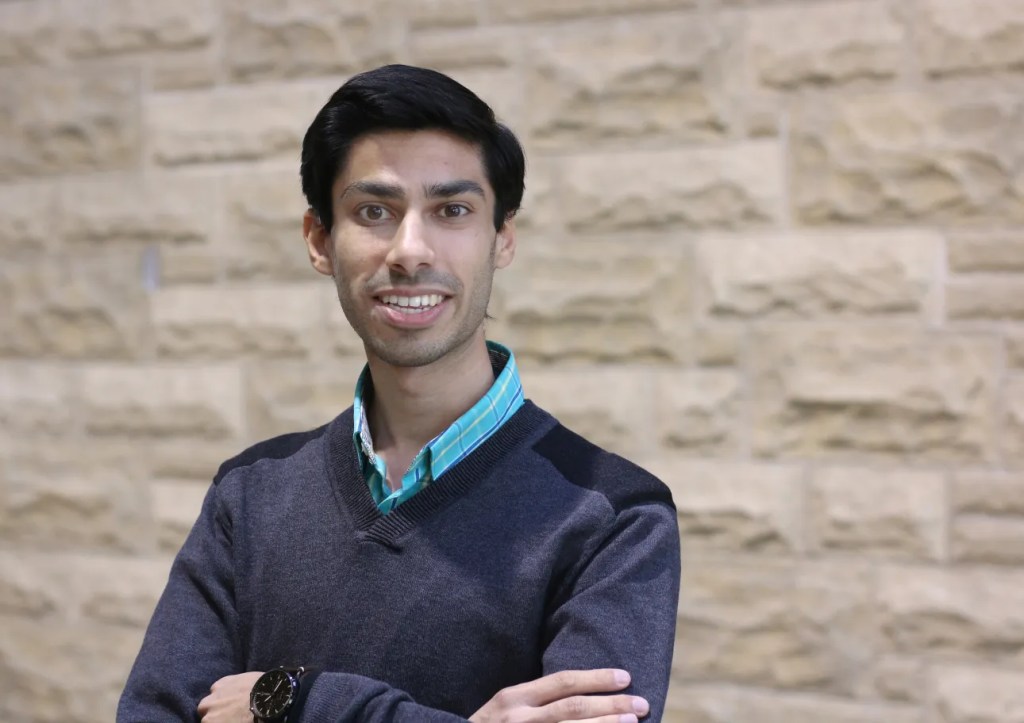
2022 IMS alumnus and medical writer at IQVIA
Photo credit: Dr. Mikaeel Valli
Dr. Valli’s journey into science and research was deeply personal. As a child, he received a cochlear implant—a hearing prosthesis—which shaped his early interactions with healthcare workers and industry professionals. This experience gave him a better understanding of the impact of medical innovation on people’s lives and sparked his interest in the biological mechanisms of cognition and perception, leading him to explore neuroscience. Dr. Valli credits this pathway with guiding him towards pursuing a career where he could contribute to advancing medical knowledge and improving patient outcomes.
This early fascination with neuroscience eventually led Dr. Valli to complete his PhD at IMS where his research involved conducting analyses on brain image scans of Parkinson’s disease patients under the supervision of Dr. Antonio Strafella. Towards the end of his PhD, Dr. Valli realized that he wanted to pursue a path in the pharmaceutical industry, which enabled him to capitalize on his previous work and research experience while providing support to patients and their families.
Dr. Valli credits the many volunteer and leadership opportunities within IMS that have helped him transition to and succeed in his current role in the pharmaceutical industry as a medical writer at IQVIA. Dr. Valli was involved with the IMS Magazine, where he started as a photographer and journalist in 2016 and was eventually promoted to co-editor-in-chief from 2021-2022. “I like the thrill of meeting different people and interviewing them,” Dr. Valli noted while reflecting on his experiences. “You meet different people, and hearing their perspectives just opens your horizons, and that encouraged me to take on more and just be entrenched in the feature article side of the magazine.” As a co-editor in chief, Dr. Valli was able to increase the magazine’s production rate back to quarterly issues post-pandemic, as well as streamline internal organization through the use of Discord to increase efficiency. This experience taught Dr. Valli leadership, project management skills, and helped him grow as a writer. “It’s certainly given me a lot of opportunities to learn and grow in terms of writing for different audiences, understanding who the audience is and being able to tailor the messages,” he explained.
Throughout his PhD studies, Dr. Valli participated in several professional development initiatives, including the Industry Team Case Study program organized by the Life Sciences Career Development Society (LSCDS). This opportunity enabled Dr. Valli to work on an industry case study collaborating with fellow grad students mentored by a pharmaceutical industry professional on a simulated project in regulatory affairs which sparked his interest in the pharmaceutical industry. These experiences gave Dr. Valli a practical understanding of industry workflows and allowed him to determine that this pathway was right for him.
After setting his sights on a pharmaceutical industry role, Dr. Valli completed his graduate diploma in Pharmaceutical & Healthcare Management and Innovation at Queen’s University following his PhD from IMS. As part of the program he was placed in a medical affairs associate role at Eisai Canada which solidified his foundational understanding of the pharmaceutical industry. In this role, he gained hands-on experience about how scientific research is translated into real-world therapies, regulatory processes, and clinical applications.
Dr. Valli has capitalized on these skills in his current role as a medical writer at IQVIA, a provider of biopharmaceutical development, professional consulting, and commercial outsourcing services. IQVIA primarily specializes in Phase I-IV clinical trials, laboratory and analytical services, and investment strategy and management consulting. Dr. Valli frequently applies the scientific communication skills that he developed while working on the IMS Magazine, for example, to translate knowledge from publications to the broader prescribers of those novel therapies. “If we are working on a project that is trying to highlight a new drug that treats patients in oncology, we would tailor and produce materials that translate that knowledge of the publication to the oncologist in a scientifically fair, balanced, and compliant way,” Dr. Valli explained as an example.
Beyond summarizing safety and efficacy data, this also means tailoring the content to the needs of different specialists, ensuring that general practitioners, pharmacists, and other healthcare professionals receive the most relevant and accessible information for their roles. One of the aspects Dr. Valli enjoys most about his current position is the opportunity to bridge the gap between research and clinical application. Whether that involves using clinical trial protocols and CSRs (clinical study reports) to develop manuscripts, abstracts and posters; or using manuscripts to develop training materials for pharmaceutical teams (via infographics or slide decks) or educational materials for healthcare professionals, he is able to make complex scientific information clear and accessible. For Dr. Valli, the most rewarding part is knowing that his work helps different healthcare professionals make informed decisions about new therapies to ultimately improve patient care.
Finally, when asked about any advice he had for students looking to make the change from academia to industry, Dr. Valli stresses the importance of always networking and looking for any occasion to work with industry partners to “get a flavour of these different opportunities. And because of those industry experiences that you get early on, the more you can use them as leverage for success beyond your PhD.”
Dr. Valli’s advice on transitioning to industry can be summarized by three main points. First, develop transferable skills during graduate studies, such as leadership, communication, and teamwork, as these are just as important as technical expertise. Second, continuously refine your scientific communication skills to effectively tailor and convey scientific data to any audience—an invaluable skill in any career path. Lastly, take the time to network and learn about different roles in industry through internships, informational interviews, and professional organizations—Dr. Valli suggests that students “should explore and read about the different roles within the pharmaceutical industry with an open mind, [and] appreciate different roles and the impact that they potentially have.” Overall, our discussion highlights that the field of medical research is vast, and there are many opportunities to impact healthcare both within and outside traditional academia. Dr. Valli’s journey exemplifies how diverse career paths in the scientific field can all offer a way to make a difference in patients’ lives.
 IMS Magazine
You must be logged in to post a comment.