

By Katherine Guo
Graphic design by Anaiah Reyes
If you’re a student at the Institute of Medical Science (IMS), you’ve probably heard of Stefan Aguiar. From leading two separate student organizations to patient recruitment and research, Stefan does it all.
As a PhD student at IMS, most of Stefan’s thesis work takes place at Princess Margaret Hospital (PMH), where he is supervised by Dr. Madeline Li. Stefan focuses on psychosocial oncology as well as palliative and end-of-life care for patients who have requested medical assistance in dying (MAiD). When discussing his initial interest in the field, his family is always at the forefront of the conversation.
He initially describes how his parents immigrated from India to help with his chronic asthmatic conditions and to escape the poor air quality and pollution in his hometown. So, when Stefan began his undergraduate degree at the University of Toronto in 2018, he set his sights on majors related to immunology where he could learn more about allergies, asthma and cancer. His choice of joining Trinity College, which has a strong focus on immunology, cemented his interest. With his mind made up, he specialized in the Immunology and Health and Disease streams in 2020.
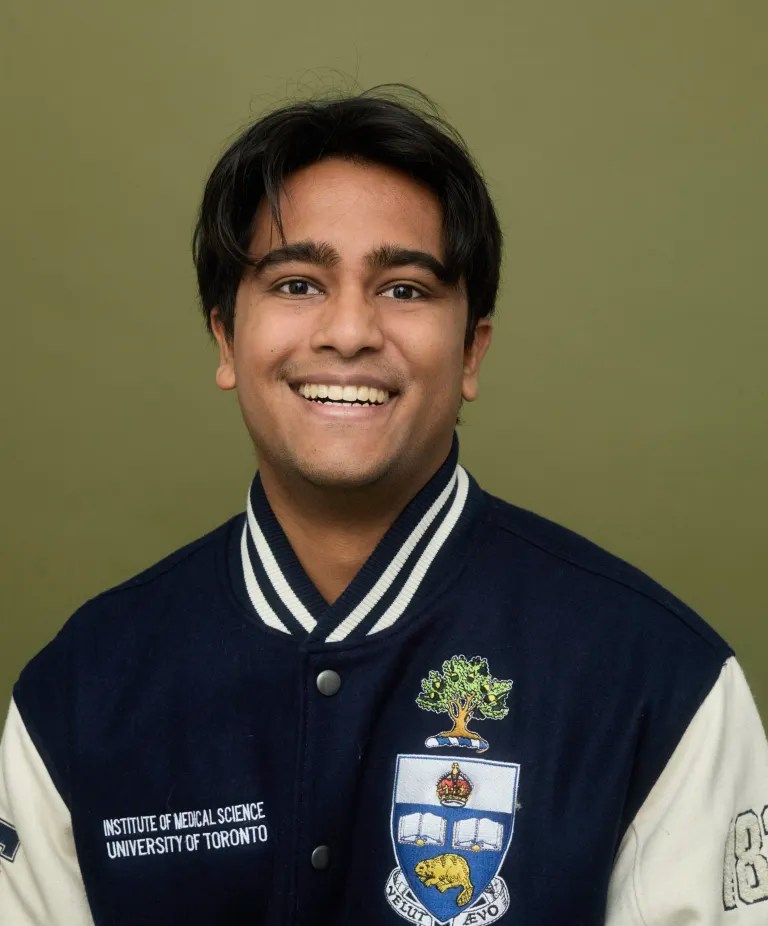
PhD Candidate and 2024-2025 IMSSA Co-President
Photo credit: Stefan Aguiar
Although becoming a physician was on the table, Stefan was also interested in pursuing a career in research. Cutting-edge microbiome research was a hot topic in the world of gut immunology, so when presented with the chance to work with gut immunology researchers Dr. Dana Philpott and Dr. Thierry Mallevaey midway through his undergraduate degree, Stefan jumped at the opportunity. His project focused on the NOD2 receptor and its role in innate immune system activation via gut bacteria. Stefan’s role was to work on a cellular model to test for receptor activation.
Stefan enjoyed his research work so much that he joined the Immunology Summer Student Research Program and continued with the lab to complete his 4th-year thesis. Soon, he began looking into graduate school, knowing the process was another chance to refine his research focus. When he talks about deciding the kinds of supervisors to apply to, he again goes back to his family.
He describes how his grandfather “suffered for a very long time” from cancer as well as the discrepancy between his experience and his studies. His undergraduate degree had been somewhat detached and depersonalized; it was all mechanisms, cell biology, and treatments. But after witnessing, firsthand, what it was like for patients in an oncology unit, Stefan was interested in something more holistic.
“What about the human aspect of it? People actually suffering with cancer—are we taking care of them?”
While searching for a supervisor, Stefan came across Dr. Li, whose work was primarily focused on both immunology and cancer within the context of end-of-life care. Although it was a big switch from benchwork, it was a perfect match—allowing him to explore both of his research interests in a dry-lab environment.
Now, Stefan interviews patients in PMH’s oncology unit who have requested MAiD, combining both qualitative and quantitative data with the goal of teasing out the nuances related to their experiences and patient profiles. Recruited patients also complete psychometric questionnaires every six months to assess the various psychosocial factors impacting their wellbeing. Stefan recalls the beginning of his work as particularly challenging since “there’s no formal training before you talk to patients who are about to die.”
Recruited patients are in the later stages of cancer, often with a life expectancy of 2 years at maximum. While some patients are interviewed far in advance of their MAiD date, other interviews take place only a week before. It goes without saying that the work is emotionally demanding.
Despite the emotional toll, Stefan reflects on his work and the people he’s met with reverence—grateful to have been allowed into their lives, however brief. “These patients are at the last stages of their life,” he says. “I see it as having the privilege to go and spend that time with them.”
His interviews represent more than just data collection. He learns who these patients are as individuals and the kinds of interests they have—if they like to play games or if they like to hike.
Stefan seeks out these connections not only in his academic career, but outside of it as well. Throughout his undergraduate degree, between courses, work, and the long commute from Vaughan to downtown Toronto, Stefan spent most of his time in the library, the lab, or on transit. When he entered graduate school, he knew he wanted a change.
During his orientation, Stefan was convinced to join UofT Talks, where he helped organize a student-led conference on nutritional science. Kyla Trkulja, the PMH site director that year, also convinced Stefan to get involved with IMS Student Association (IMSSA). She passed on the torch to Stefan where he succeeded her as site director in his second year. There, Stefan also became involved with IMSSA’s Warm Hands for Cold Streets event and party planning committee in addition to his role as site director.
IMSSA’s annual Warm Hands for Cold Streets event is particularly memorable for him. Every year, different research sites with IMS collect donations to provide warm clothing and essential items to those in the city who may otherwise lack access. During his second year, Stefan helped lead the event, and to this day, it remains “one of the best experiences” he’s ever had, recalling how the people he met were always so genuine and grateful.
At the end of his second year, Stefan and Hamzah made their bid for co-presidents of IMSSA. Now, in his third year, Stefan is the co-president of UofT Talks alongside Anthaea-Grace Patricia Dennis, and is also co-president of the IMSSA with Hamzah Khan.
All the additional responsibility keeps Stefan’s day-to-day busy with endless texts and emails about event logistics. That’s without even mentioning the many side projects he’s working on within IMS, from creating a web app to a methodology seminar—which may turn into a course in the future!
The support Stefan receives through the people in his life has been essential in helping him manage all his current responsibilities. He cites his supervisor as one of the reasons he’s able to stay so involved—her encouragement has often pushed him to take that first step, and she goes “above and beyond” to make sure Stefan has what he needs both in terms of his academics and his career.
Despite the significant workload, it’s clear that it’s something Stefan enjoys—the people he meets, the connections he makes, and the laughs they share keep him going. Stefan hopes to continue making these connections and pursue a career in palliative care and oncology by pursuing an MD specializing in these fields in the future.
“It’s so precious, and I’m so grateful that I get these opportunities with people, and that’s how I know that’s what I want to do.”
 IMS Magazine
You must be logged in to post a comment.