

By Priya van Oosterhout
Graphic design by Jeah Kim
There are two universal truths in graduate school: first, that it is unpredictable, and second, no two students will share the same journey. Institute of Medical Science (IMS) alumni Dr. Paul Kudlow’s exceptional career has embodied these truths, combining the best of academia, clinical practice, and industry. Sitting down with Dr. Kudlow, a clinician-teacher at Sunnybrook Health Sciences Centre, assistant professor in the Department of Psychiatry at the University of Toronto, and founding partner of venture capital firm North South Ventures, I had the opportunity to discuss how his journey has led to where he is today, and how pulling from different areas of expertise has shaped his success thus far.
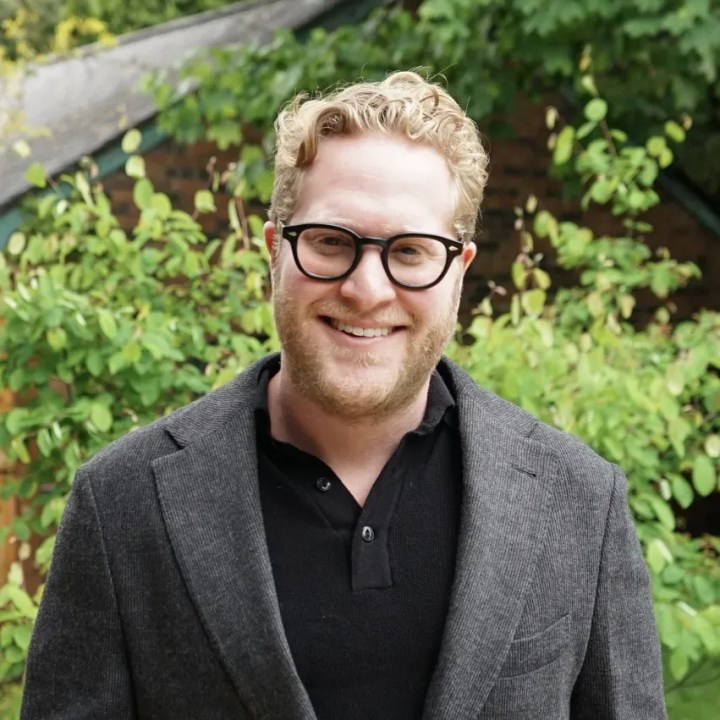
Photo credit: Dr. Kudlow
After completing his undergraduate degree in physiology and management, Dr. Kudlow faced a choice between the two worlds he was a part of: investment banking, or medicine. However, as fate would have it, the economic crash in 2008 pushed him towards the latter. Pursuing his fascination with human physiology, Dr. Kudlow began medical school at Western University, where he discovered his love of research while conducting a study on the use of cognitive enhancers (such as caffeine and stimulants) among Canadian medical students. With his newfound interest in medical research, Dr. Kudlow explains that psychiatry is “one of the fields with the most research opportunity, because it is very much at the frontier of medicine.” It was during this first foray into research where he first encountered what he calls “the discovery problem in academia,” in which researchers often struggle to parse the literature to find the exact data or studies relevant to their work. To tackle that discovery gap, Dr. Kudlow co-founded TrendMD, a “recommended-for-you” bar for scholarly articles. When readers finish a paper online, TrendMD suggests links to other studies on related questions, helping researchers uncover useful work they might otherwise miss. The tool now appears on thousands of journals and delivers more than 150 million tailored recommendations each month. When discussing this transition from medical student to CEO, it almost sounded simple. At least at first.
How does one even start a company? What does it mean to be a CEO? “Honestly,” Dr. Kudlow laughs, “I’m still figuring that out.” In TrendMD’s early days he met his co-founder online, spent two years building the product and raising seed capital, and likens the experience to “stumbling through a dark basement—you spot one obstacle with a flashlight, solve it, then move on.” As TrendMD scaled, the demands of a growing startup and a psychiatry residency collided, so he took an academic leave, turned TrendMD data into a PhD in bibliometrics, divested his stake in 2019, and finished residency. During the first wave of COVID-19 he co-founded North South Ventures, a venture capital firm which backs early-stage health-tech and biotech teams aiming to improve patient outcomes and make health systems run better. “After TrendMD,” he says, “it was my turn—let’s see if I can pick companies, not just build one.”
Breakthroughs in biotech and health-tech are rare, so NSV looks for discoveries that could meaningfully shift patient care even when the odds are long. One example is YourChoice Therapeutics, developer of the first non-hormonal, reversible male contraceptive pill. Seeing its potential to reshape family planning, NSV backed the company early, with Dr. Kudlow excitedly stating that it “could change the world.” As NSV attracts more capital, he aims to write larger cheques sooner, pairing those investments with a network of clinicians, scientists, and operators who can speed a project’s path to patients. His goal, he says, is to “take science straight from the bench—or the bedside—to the people who need it.”
While his exploits in industry are certainly very impressive, when asked about what he’s most proud of, Dr. Kudlow unequivocally says that it is his clinical work. Working as an inpatient psychiatrist at Sunnybrook, he speaks about how important it is being a part of a patient’s care journey, stating, “working one-on-one with patients gives me a level of purpose no spreadsheet can match.” He also performs psychiatric interventions, treating individuals with severe depression and working closely with them to enhance their quality of life. His clinical practice has also informed his work at NSV, giving him perspective on patient needs, and the challenges involved in administering healthcare. This led me to my next question: how does someone bridge the gap between academia, clinical practice, and industry?
Drawing on his graduate-school experience, Dr. Kudlow says academia, clinical medicine, and the startup world often feel like separate planets, each with its own gravity and ground rules. Business moves at sprint speed, powered by mottos like “move fast, break things.” Medicine, by contrast, is guided by careful protocols that put patient safety first. As Dr. Kudlow puts it, “That mantra really doesn’t work in clinical medicine. You can’t move fast and break things, otherwise people get hurt.” However, not everything is different, and he mentions that there are a lot of similarities between good business, good science, and good medicine. The key to balancing everything, he explains, is being aware of how different the three worlds are and leveraging the strengths of each to mitigate the weaknesses of the others. Industry CEOs often trumpet products long before they work, whereas scientists wait for peer-reviewed results. If each side adopted a bit of the other’s culture—faster iteration in the lab, more openness in the boardroom—breakthroughs would reach patients sooner.
As we began to wrap up our conversation, I had one final question: what is your advice for people in academia or medicine, who are looking to start their own companies, or venture into industry? For this, Dr. Kudlow had one main point that he emphasized heavily: “stop thinking, just start doing.” He explains that for most people, the biggest challenge is simply getting started, and with the introduction of artificial intelligence (AI), the market is changing at breakneck speeds, and you won’t know what obstacles you will face until you’re there to shine a light on them.
Looking back to the universal truths of graduate school, I think Dr. Kudlow is a fantastic example how unpredictable it can be. His career embodies the spirit of forging your own path during your studies, and not settling into just one box (or in this case, sector). He began his career deciding between medicine and investment banking, discovered a passion for research, and co-founded two separate companies, all the while continuing his work as a psychiatrist at Sunnybrook. Graduate school can often feel like a set pathway—masters, then PhD, then post-doc, and finally working in academia for the rest of your career. However, as Dr. Kudlow exemplifies, there are many ways to achieve success, and there is no reason why a person must choose between academia, clinical practice, and the business world. So, as Dr. Kudlow says, stop thinking and just start doing, because you never know where you may end up.
 IMS Magazine
You must be logged in to post a comment.