
by Jasmine Amini
Graphic design by Vicky Lin
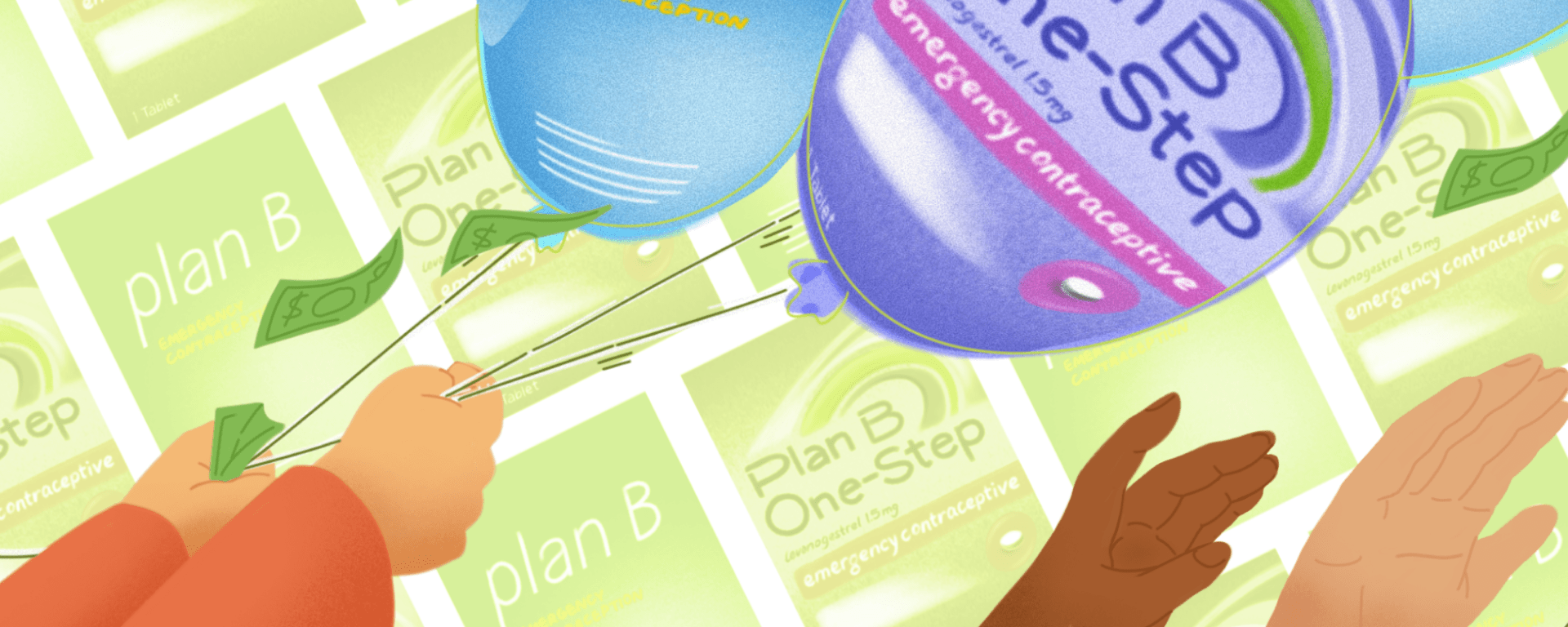
$36.99 CAD for brand name, $24.99 CAD for generic—these are prices for the two emergency contraceptive pills offered at Shoppers Drug Mart.1 Emergency contraceptive pills (ECPs), colloquially known as “the morning after pill”, are safe, effective medications that help prevent unwanted pregnancies.2 Despite their efficacy, low production cost, and availability, significant barriers hinder widely accessible ECP use among Canadians. Given that ECPs like Plan B cost approximately $0.51 CAD3 to produce, one question looms: why are ECPs so prohibitively expensive?
Perhaps unsurprisingly, mark-ups and service fees are the primary components of the whopping $30+ price tag associated with common ECPs. In Canada, ECPs are kept behind the counter of pharmacies. This means a portion of their cost is allocated to dispensing and counselling services; dispensing fees are charged at the discretion of the individual pharmacy, but in regions like British Columbia, dispensing fees for ECP prescriptions [SM1] can reach up to $20.3 ECP mark-ups are further evident when comparing their cost at pharmacies to community clinics. For example, at community-based clinic Planned Parenthood Toronto, Plan B is available for only $13 CAD; however, patients must consult with a peer health educator or clinician to obtain an ECP prescription. The bulk of ECP cost, however, comes directly from the pharmaceutical companies producing these medications. A recent investigation by the New York Times found that companies like Barr Pharmaceuticals sold Plan B prescriptions at a staggering 85% profit margin,4 which is above the average profit margin of ~76.5% among large pharmaceutical companies, according to a recent meta-analysis.5 These exorbitant profit margins have enabled the continual growth of companies producing ECPs.
To underscore the importance of equitable ECP access, it is critical to understand how these medications work. The active ingredient in ECPs is typically levonorgestrel, a synthetic form of female sex hormone progestogen.2 Levonorgestrel works to prevent ovulation of a mature egg (the female gamete), thus inhibiting fertilization by sperm. Timing of ECP use is essential, which underscores the importance of removing cost barriers. Specifically, ECPs must be used within five days of unprotected sex; however, the sooner they are taken, the more effective they are at preventing pregnancy.6 The urgency around ECP use further emphasizes the harms of prohibitive cost and lacking accessibility of these medications.
Although corporate profit-seeking is an important factor affecting ECP prices, public attitudes towards ECP use may also be a barrier to reducing costs and enacting key policy changes. In one qualitative study of post-secondary students in Ontario, several participants described traveling to distant pharmacies or pretending to purchase ECPs for another individual due to their discomfort around procuring ECPs.7 Strategies to maintain secrecy and avoid confrontation among study participants betrays a sense of shame around the use of ECPs, or of being the “type of person” who uses them. The stigma around ECP use serves not only to belittle affected individuals—it also impedes them from recognizing and confronting the ways in which companies that produce and supply ECPs exploit them. Without public rallying, the impetus to enact policy change protecting Canadians from ECP price gouging is effectively zero.
Larger organizations also perpetuate stigma around ECP use. In 2017, United Kingdom pharmacy giant, Boots, refused to reduce the price of their brand-name and generic ECP (then 44.50 CAD) over fears that doing so would “incentivize inappropriate use” among consumers.8 Although Boots eventually did walk back their stance, following suit with other major competitors, their original statement is telling of the ethos around ECP use in the Western world. In taking a traditionalist stance to disincentivize “inappropriate use”, companies like Boots are making moral judgments on consumer’s sex lives, an area over which they should have no claim, and are using said judgements to justify extortionate ECP prices.
Notwithstanding that people use ECPs for various reasons that are not “their fault”, such as broken condoms or sexual assault, justifications of ECP pricing by private entities, like Boots, on the basis of moral “wrongdoing” by consumers should raise concern. It is important to consider and scrutinize the messages that potentially underlie corporate justifications for price gouging on ECPs, which may centre around punishing “risky” sexual behaviours. It is not the role of a healthcare provider or pharmaceutical company to determine how an individual should exert their autonomy, nor is it their role to enforce what they consider as appropriate “punishment” for “inappropriate use” of ECPs. In the same way that we should continue offering care to a patient with lung cancer who smokes, we should be offering ECPs at low cost to whoever needs them, when they need them.
Concerns around access to ECPs are even more pressing in the context of Roe v. Wade, a supreme court ruling protecting abortion access in the USA, being overturned in 2022.9 With abortions being banned in 12 states, and gestational limits enforced in 29 states10, demand for ECPs skyrocketed. In the week following Roe v. Wade being overturned, one pharmaceutical company, Wisp, reported a 3000% increase in sales, and suppliers like CVS and Rite Aid implemented policies limiting the number of ECPs consumers could buy at a given time.11 Although these buying behaviours are understandable, they highlight concerning truths regarding the ECP industry, namely that ECP producers can capitalize on consumer fear and lack of choice, and that they stand to gain from legislation restricting reproductive health care.
The main challenge now is determining how we move forward. Without governmental pressure, companies are not incentivized to reduce ECP costs. This is particularly troubling due to the time-sensitive nature of these medications and that they are often the last option to prevent unwanted pregnancy, aside from the less common copper intrauterine devices. Encouragingly, our government may partner with ECP producers to subsidize ECP cost for Canadian consumers. Bill C-64, or the Pharmacare Act, aims to do just that. Specifically, Bill C-64 proposes to enhance pre-existing provincial and territorial drug benefit programs, offering single-payer coverage for a variety of prescription medications.12 Alongside diabetes medication, contraceptive devices and medications will be the first prescriptions covered under Bill C-64.
Although recent legislative action is promising, the fight to ensure stigma-free access to ECPs, and contraceptive care broadly, remains ever-present. As the overturning of Roe v. Wade has shown, access to reproductive healthcare is tenuous and can be rescinded with changing political landscapes. In an era where reproductive healthcare is continually threatened, it is critical to be vocal against restrictions to ECP access. Far from being a source of shame, access to ECPs and reproductive care should be viewed as an important cornerstone of the Canadian healthcare system, one that values and upholds individual autonomy for all.
References
1. Buy Contraceptives Products Online | Shoppers Drug Mart, https://www.shoppersdrugmart.ca/shop/categories/health/sexual-wellness-and-family-planning/sexual-wellness/contraceptives/c/FS-HT-S102?sort=trending&page=0&lang=en (accessed 26 April 2025).
2. Vrettakos C, Bajaj T. Levonorgestrel. In: StatPearls. Treasure Island (FL): StatPearls Publishing, http://www.ncbi.nlm.nih.gov/books/NBK539737/ (2025, accessed 19 April 2025).
3. CFP Services Chart: Services, fees and claims data for government-sponsored pharmacy programs.
4. Sorkin AR, Giang V, Gandel S, et al. Who’s Profiting From Demand for Plan B? The New York Times, 28 June 2022, https://www.nytimes.com/2022/06/28/business/dealbook/plan-b-contraception-pills-profit.html (28 June 2022, accessed 19 April 2025).
5. Ledley FD, McCoy SS, Vaughan G, et al. Profitability of Large Pharmaceutical Companies Compared With Other Large Public Companies. JAMA 2020; 323: 834–843.
6. Gemzell-Danielsson K, Berger C, P.g.l. L. Emergency contraception — mechanisms of action. Contraception 2013; 87: 300–308.
7. Szajbely K, Neiterman E. Exploring the experiences of Ontario post-secondary students with the emergency contraception pill. J Obstet Gynaecol Can 2025; 102825.
8. Boots “ends grossly sexist surcharge” and lowers the price of emergency contraception following years of campaigning by charities and MPs. BPAS Campaigns, https://bpas-campaigns.org/news/boots-ends-grossly-sexist-surcharge-and-lowers-the-price-of-emergency-contraception-following-years-of-campaigning-by-charities-and-mps/ (accessed 20 April 2025).
9. Totenberg N. Supreme Court overturns Roe v. Wade, ending right to abortion upheld for decades. NPR, 24 June 2022, https://www.npr.org/2022/06/24/1102305878/supreme-court-abortion-roe-v-wade-decision-overturn (24 June 2022, accessed 5 May 2025).
10. U.S. Abortion Policies. KFF, https://www.kff.org/interactive/womens-health-profiles/united-states/ (accessed 5 May 2025).
11. Pharmacy sees 3,000% jump in emergency contraceptive sales after Roe ruling – CBS News, https://www.cbsnews.com/news/emergency-contraception-roe-v-wade-plan-b-spike-in-sales-wisp/ (2022, accessed 5 May 2025).
12. Canada H. Universal Access to Contraception, https://www.canada.ca/en/health-canada/news/2024/02/backgrounder-universal-access-to-contraception.html (2024, accessed 22 April 2025).
 IMS Magazine