

By Kowsar Teymouri
Graphic design by Athena Li
Cancer is a leading cause of death in Canada, with one in every 2.2 Canadians expected to be diagnosed with cancer in their lifetime.1 Cancer screening has been proven to reduce cancer morbidity and mortality rates;2 thus, it is a crucial part of primary care in Ontario.3 Despite efforts to provide comprehensive cancer screening for the entire population at no cost, there are well-documented inequities across Ontario, especially for people of low socioeconomic status, people living in low-income neighbourhoods, and immigrants. These complex barriers exist at the level of the patient, provider, and overall healthcare system.
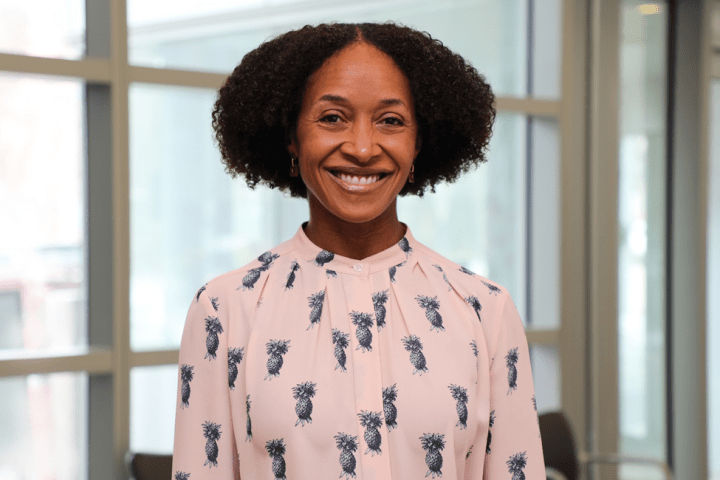
Associate Professor, University of Toronto
Photo credit: Dr. Aisha Lofters
Dr. Aisha Lofters, a family physician and clinician-scientist at Women’s College Hospital, and an Associate Professor at the Institute of Medical Science and Dalla Lana School of Public Health, has dedicated her research to investigating health inequities in cancer screening. Social justice was always at the forefront of Dr. Lofters’ upbringing, which cultivated her strong interest in addressing inequalities, regardless of the career path she chose.
After obtaining her medical degree at the University of Maryland, Dr. Lofters completed her residency and fellowship in family medicine at the University of Toronto (UofT). Dr. Lofters was interested in family medicine as it prioritizes powerful, but simple tools: prevention and screening. Dr. Lofters believes that while cancer treatment is important, “catching it early can really change the trajectory of someone’s life.” During her residency, Dr. Lofters, under the supervision of Dr. Rick Glazier from St. Michael’s Hospital, investigated cervical cancer screening in areas with higher proportions of new immigrants and low-income individuals. This project inspired her to pursue her PhD in Clinical Epidemiology and Health Care Research at UofT and later become a clinician-scientist.
Dr. Lofters’ research aims to answer the fundamental question: “Where are the inequities in care?” To do so, she leverages quantitative methods on population-level data to address where and for whom these inequities in cancer screening exist. Then, she implements qualitative methods to gain a deeper understanding of why these disparities exist and eventually identify solutions for alleviating them. Dr. Lofters believes there is an interplay between discrimination on the bases of income, race, and immigration, which contribute to these disparities—highlighting the underlying theme of health equity in her work.
Dr. Lofters’ work has a particular focus on cervical cancer screening. Her studies have demonstrated that immigrant women who are newer to the country, as well as those living in low-income neighbourhoods, had lower uptake of available screening programs.4 Screening rates also varied among immigrant women, with the lowest rates observed in South Asian, Middle Eastern, and North African women. Considering Ontario’s universal healthcare system covers the direct financial cost of cervical cancer screening, understanding the indirect costs that prevent usage in these populations is important. To address this, Dr. Lofters, in collaboration with Dr. Mandana Vahabi, has conducted qualitative studies on Muslim women from the aforementioned countries.4,5 Cultural barriers pertaining to modesty and privacy—particularly with limited same-gendered providers—as well as access to transportation and childcare, limit visitations. Furthermore, some patients lack access to a general practitioner and have limited knowledge about cervical cancer screening, restricting their ability to self-advocate. In some instances, patients didn’t have the opportunity to be screened as the test was not offered to them. This study highlights key patient, and importantly, practitioner factors which are important to consider when determining the effective uptake of screening programs.5,6
Human Papillomavirus (HPV) infection is responsible for nearly all cervical cancer cases.7 Ontario Health recommends conducting an HPV test as part of its cervical cancer screening program.8 However, the experience of having a healthcare provider collect a vaginal swab could be traumatizing or uncomfortable for some women, which may discourage them from undergoing screening. HPV self-collection kits offer an alternative which allows patients to collect the swab at home. Currently, HPV self-collection kits have been implemented in British Columbia, Australia, and parts of Europe. Dr. Lofters has studied the acceptability and uptake of these kits in Ontario and is currently investigating the most effective ways to implement them into the province’s cervical cancer screening program.9
In addition to the concerns associated with the screening process, some patients also delay seeking care following a previous unpleasant experience with the healthcare system or a lack of knowledge about the symptoms. Dr. Lofters said that “in Canada, cancer is not a death sentence.” In fact, two in five Canadians will develop cancer over their lifetime, and only one in five will die from it.10 Healthcare providers should, therefore, educate patients about the symptoms and create a safe space where patients feel comfortable seeking care before it is too late.
Dr. Lofters’ work extends beyond cervical cancer. In collaboration with Dr. Ambreen Sayani, she has investigated lung cancer in marginalized communities.11 They observed that rates of lung cancer are higher among low-income individuals, and this correlates with increased smoking rates in the low-income population. 11 Further stigmatization surrounding income status and smoking may compound to create additional barriers to care in these populations.11
As Canada’s immigration rates rise, Dr. Lofters emphasized that the healthcare system should monitor health outcomes in immigrants and how they are influenced by their home country, income, and immigration path. According to Dr. Lofters, “looking at immigrant health is looking at the health of our population.” In addition, Dr. Lofters believes that we, as the general public, can alleviate the healthcare disparities by recognizing and leveraging our power and privilege to support others in society.
Cancer screening has proven to reduce cancer-related morbidity and mortality. Dr. Lofters is leveraging her expertise and passion for health equity to address the needs of marginalized populations to enhance cancer screening programs in Ontario. Dr. Lofters’ advice to young investigators interested in studying health inequities is to find the niche that they are most excited about, as there are still many opportunities in this realm to address the historical gaps in the field.
References:
1. CCSD | Home [Internet]. [cited 2025 Aug 13]. Available from: https://cancerstats.ca/
2. Cancer | Ontario Health [Internet]. [cited 2025 Aug 13]. Available from: https://www.ontariohealth.ca/clinical/cancer
3. Lofters AK, Mark A, Taljaard M, et al. Cancer screening inequities in a time of primary care reform: A population-based longitudinal study in Ontario, Canada. BMC Fam Pract. 2018;19(1).
4. Lofters AK, Hwang SW, Moineddin R, et al. Cervical cancer screening among urban immigrants by region of origin: A population-based cohort study. Prev Med (Baltim). 2010;51(6).
5. Lofters AK, Vahabi M, Kim E, et al. Cervical cancer screening among women from Muslim-majority countries in Ontario, Canada. Cancer Epidemiology Biomarkers and Prevention. 2017;26(10).
6. Marshall S, Vahabi M, Lofters A. Acceptability, Feasibility and Uptake of HPV Self-Sampling Among Immigrant Minority Women: a Focused Literature Review. Vol. 21, Journal of Immigrant and Minority Health. 2019.
7. Walboomers JMM, Jacobs M V., Manos MM, et al. Human papillomavirus is a necessary cause of invasive cervical cancer worldwide. Journal of Pathology. 1999;189(1).
8. Cervical Screening | Cancer Care Ontario [Internet]. [cited 2025 Aug 13]. Available from: https://www.cancercareontario.ca/en/types-of-cancer/cervical/screening?utm
9. Devotta K, Vahabi M, Prakash V, et al. Reach and effectiveness of an HPV self-sampling intervention for cervical screening amongst under- or never-screened women in Toronto, Ontario Canada. BMC Womens Health. 2023;23(1).
10. Lifetime probability of developing and dying from cancer in Canada – Statistics Canada [Internet]. [cited 2025 Aug 20]. Available from: https://www.statcan.gc.ca/o1/en/plus/4547-lifetime-probability-developing-and-dying-cancer-canada?utm
11. Ruco A, Lofters AK, Lu H, et al. Lung cancer survival by immigrant status: a population-based retrospective cohort study in Ontario, Canada. BMC Cancer [Internet]. 2024 Dec 1 [cited 2025 Aug 14];24(1):1114. Available from: https://pmc.ncbi.nlm.nih.gov/articles/PMC11380402/
 IMS Magazine
You must be logged in to post a comment.