
by Mia Feldman
Graphic design by Raymond Zhang
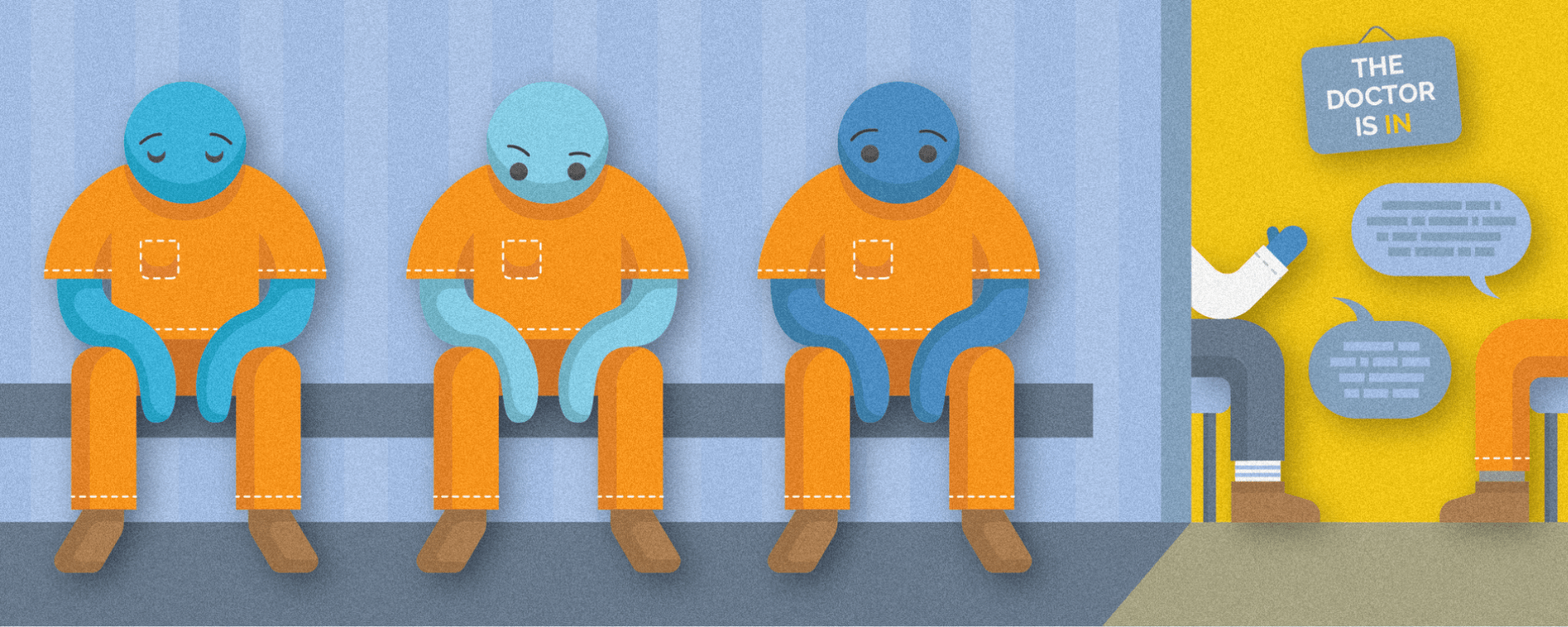
In Canada’s federal prisons, prisoners are not only deprived of their physical freedom, but also of their fundamental human right to healthcare. While incarcerated, individuals are considered wards of the state, meaning the government has a legal obligation to provide a standard level of healthcare.1 Nevertheless, despite legislation, many incarcerated people in Canada continue to experience substandard healthcare. The manifest function of the carceral system is to offer a measure of safety and justice to victims of crime by removing offenders from society and limiting their freedom of mobility; however, a latent consequence of imprisonment is the alienation of other human rights, such as the right to healthcare.
In Canada, adults sentenced to two or more years in prison are sent to a federal penitentiary managed by Correctional Services Canada (CSC). Despite existing legislation, the CSC consistently fails to meet a basic standard of care.2 As a result, entering prison with a pre-existing health condition can have severe consequences. One of many examples is in the case of Garrie Garrell, who sued the federal government in 2021 over the inadequate care he received while incarcerated at Beaver Creek Institution in Gravenhurst, Ontario.3 Garrell lives with chronic obstructive pulmonary disease and heart disease which, prior to his incarceration, was manageable. While incarcerated, federal staff denied him oxygen, medication, and appointments with specialists, resulting in an early release due to worsening health. As a result of neglectful care, Garrell is now completely incapacitated by his condition.3
When considering antecedents to healthcare inequality in prison, systemic issues are abound. Understaffing and underfunding of prison healthcare often leads to gaps in care and burnout among available clinicians and nursing staff.4 For example, a 2025 systemic review found that nurses are reluctant to take employment at prisons because of the reputation these roles have for being draining and stressful, perpetuating the understaffing.4 Policy changes that provide staff with more resources to work with, including specialized providers for specific problems (i.e. social workers for mental healthcare), may break this cycle of understaffing; however little support of this kind exists. Beyond resource barriers, the relationship between healthcare providers and inmates is shaped by a deep social divide. Canadian prisoners have reported experiencing an “us vs. them” mentality when seeking care from providers, who often hold negative attitudes towards prisoners.2,5 For example, healthcare providers may accuse prisoners of being drug-seeking or malingering and ignore their concerns.2
In addition to exacerbating pre-existing conditions, many leave prison with new health conditions they were less likely to develop before incarceration. The incidence of HIV, hepatitis, and tuberculosis are all significantly greater in prison than among the general population.6-8 This is likely due to poor standards of hygiene, limited preventative medical practices (e.g. clean needle exchange programs), and lacking access to vaccinations.6, 7 In addition, incarceration often results in individuals developing new severe mental health disorders, such as PTSD.9 A 2015 review of incarceration and health outlines that being separated from family and witnessing violence in prison are strong risk factors for the development of mental illness.10 These physical and psychological harms reveal that incarceration is not only a legal punishment, but a public health crisis itself.
Prison as a cause of poor health has been identified in Canada for almost 10 years.11 Specifically, the very structure of incarceration—marked by isolation from community and family, restricted autonomy, the physical and psychological abuse common from prison staff, and a focus on constant punishment—directly contributes to deteriorating health.2,10,11 Researchers have identified a phenomenon known as “accelerated aging” among inmates, where the chronic stress of living in overcrowded and under-resourced prisons causes biological age to outpace chronological age by 10-15 years.12 Thus, solving this crisis requires more than simply expanding access to healthcare in prison. The evidence is clear, prison is not only a symptom of a failing healthcare system, but also a driver of poor health outcomes itself. To uphold the health and dignity of Canadians, we must consider adopting decarceration as a central component of public health policy.
Opponents of decarceration worry about public safety and support systems of retribution. However, as it stands today, nearly three quarters of prisoners in Canada are serving time for nonviolent crimes, such as possession of illicit substances.13 Given the fairly low risk that these individuals pose to public safety and the relatively high risk of them experiencing inadequate care, alternative modes of justice, such as mandatory community service, may offer more productive strategies to manage risk. Decarceration strategies should also be paired with robust community-based supports and rehabilitation services. A 2021 review found that across the United States, programs such as early childhood education, nurse family partnerships, and provision of housing improved community health outcomes when paired with decarceration efforts.14 Healing lodges are another alternative to incarceration for Indigenous folks. Rooted in rehabilitation over punishment, they use traditional values and culturally relevant services, such as access to Elders, ceremonies, and interactions with nature to guide holistic healing.15 A 2022 report on Canadian healing lodges found that participation significantly decreased the risk of revocation of release by 54% for Indigenous men and 65% for Indigenous women.16 Emphasis on recovery and restoration at these lodges reduces risk of future incarceration. Only by reimagining the function of justice systems and prioritizing social supports over punishment can the years of life lost to incarceration be reduced and true health equity achieved.
The health inequalities within Canadian prisons underscore a deeper truth; incarceration is an important structural determinant of health for prisoners and their families. Critically, incarceration strips individuals of autonomy, safety, and access to care, undermining the foundations of wellbeing. If we are serious about protecting public health, we must confront the prison system as a site of harm and invest in robust, community-based alternatives that centre healing and social support. Ultimately, we must recognize that decarceration is not a departure from justice, but a necessary step towards a more equitable and healthy society.
References
- Corrections and Conditional Release Act, S.C. 1992, c. 20Miller A. Prison health care inequality. CMAJ. 2013 Apr 2;185(6):E249-50.
- Miller A. Prison health care inequality. CMAJ. 2013 Apr 2;185(6):E249-50.
- Barrera J, Loiero J. This man is on his deathbed because of the health care he received in prison, lawsuit alleges. CBC News [Internet] 2021 Mar 5: CBC Investigates.
- Hanby L, Ridha T, Sullivan R, et al. Indigenous Healing Lodges: Impacts on Offender Reintegration and Community Outcomes. Correctional Service of Canada. 2022.
- Shelton D, Roscoe LE, Kapetanovic TA, Smith S. The Correctional Nursing Workforce Crisis: An Innovative Solution to Meet the Challenge. J Correct Health Care. 2025 Apr;31(2):82-89.
- Veilleux C, Roach P, Cooke L, Pfeffer G, Johnson N, Ganesh A. Implicit Bias and Health Disparities in the Incarcerated Population: A Review With a Focus on Neurological Care and the Canadian Perspective. J Neuro Res. 2022;12(2):34-42.
- Zakaria D, Thompson JM, Jarvis A, Borgatta F. Summary of emerging findings from the 2007 National Inmate Infectious Diseases and Risk-Behaviours Survey. Ottawa, ON: Correctional Service of Canada; 2010.
- Ford PM, Pearson M, Sankar-Mistry P, Stevenson T, Bell D, Austin J. HIV, hepatitis C and risk behaviour in a Canadian medium-security federal penitentiary. Queen’s University HIV Prison Study Group. QJM. 2000;93(2):113-9.
- Canadian Thoracic Society. Canadian tuberculosis standards. 7th ed. Ottawa, ON: Canadian Thoracic Society, Public Health Agency of Canada; 2013.
- Piper A, & Berle D. The association between trauma experienced during incarceration and PTSD outcomes: a systematic review and meta-analysis. J. Forensic Psychiatry Psychol. 2019 July:30(5):854–875.
- Massoglia M, Pridemore WA. Incarceration and Health. Annu Rev Sociol. 2015 Aug;41:291-310.
- Kouyoumdjian F, Schuler A, Matheson FI et al. Health status of prisoners in Canada: Narrative review. Can Fam Physician. 2016 Mar;62(3):215-22.
- Reagan L, Kitt-Lewis E, Loeb SJ, Shelton D, Zucker DM. Health equity for people living in correctional facilities: Addressing bias, stigma, and dehumanization. Res Nurs Health. 2024 Aug;47(4):359-365.
- Corrections and Conditional Release Statistical Overview 2022. Ottawa, ON. Public Safety Canada; 2022.
- Hawks L, Lopoo E, Puglisi L, Cellini J, Thompson K, Halberstam AA, Tolliver D, Martinez-Hamilton S, Wang EA. Community investment interventions as a means for decarceration: A scoping review. Lancet Reg Health Am. 2021 Dec 21;8:100150.
- Correctional Service Canada. Healing Lodges: A path to rehabilitation and reconnection. Government of Canada [Internet] 2024 Sept 7: Let’s Talk.
 IMS Magazine