
By Mya Chronopoulos and Michellie Choi
Graphic design by Josip Petrusa
Sirens fade as the doors to the hospital swing open. Before the wheels of the stretcher even lock, a physician is already at work—glancing at monitors, issuing orders, and making split-second decisions that leave no room for hesitation. In these moments, one minute may be the difference between life and death. This is the image that comes to mind when one imagines emergency medicine. The moments preceding what happens in the trauma bay are critical—but often overlooked. These moments are the ones that Dr. Brodie Nolan aims to optimize to promote better outcomes in trauma care.

Institute of Medical Science, Institute of Health Policy, Management and Evaluation
Dr. Nolan is an emergency and trauma team leader at St. Michael’s Hospital, as well as a transport physician with Ornge, Ontario’s air ambulance service. Initially uncertain of his career path, Dr. Nolan enrolled at Wilfred Laurier University for his undergraduate studies. During orientation, he witnessed a student collapse a few rows in front of him, and the coordinated response of first responders immediately drew his attention. Inspired, he began volunteering across campus, assisting first responders by supplying oxygen and medical equipment—an experience that provided early exposure to the intensity of emergency care. Dr. Nolan later attended medical school at the University of Toronto, where he gravitated towards emergency and trauma medicine. “In trauma, you’re dealing with some of the sickest patients in the country, but this allows more time to get to know one patient and their family,” Dr. Nolan says.
As a researcher, Dr. Nolan focuses on optimizing care in the first hour after traumatic injury–what trauma physicians call “the golden hour”. For trauma patients, such as those experiencing massive bleeding, timely care within this small window of time is critical for ensuring good outcomes. “In studies looking at patients with massive bleeding, for every one-minute delay in getting a blood transfusion, their odds of death go up by five percent,” Dr. Nolan says.
Speed and efficiency in trauma care depend largely on the location of the incident. As Dr. Nolan explains, “If you can’t change where people live, then you need to be able to bring the hospital to them—a challenge known as the “tyranny of distance.” While downtown Toronto is minutes away from two level I trauma facilities, many rural regions of Ontario are hours from specialized care. Through his work, Dr. Nolan hopes to eliminate this barrier to timely care.
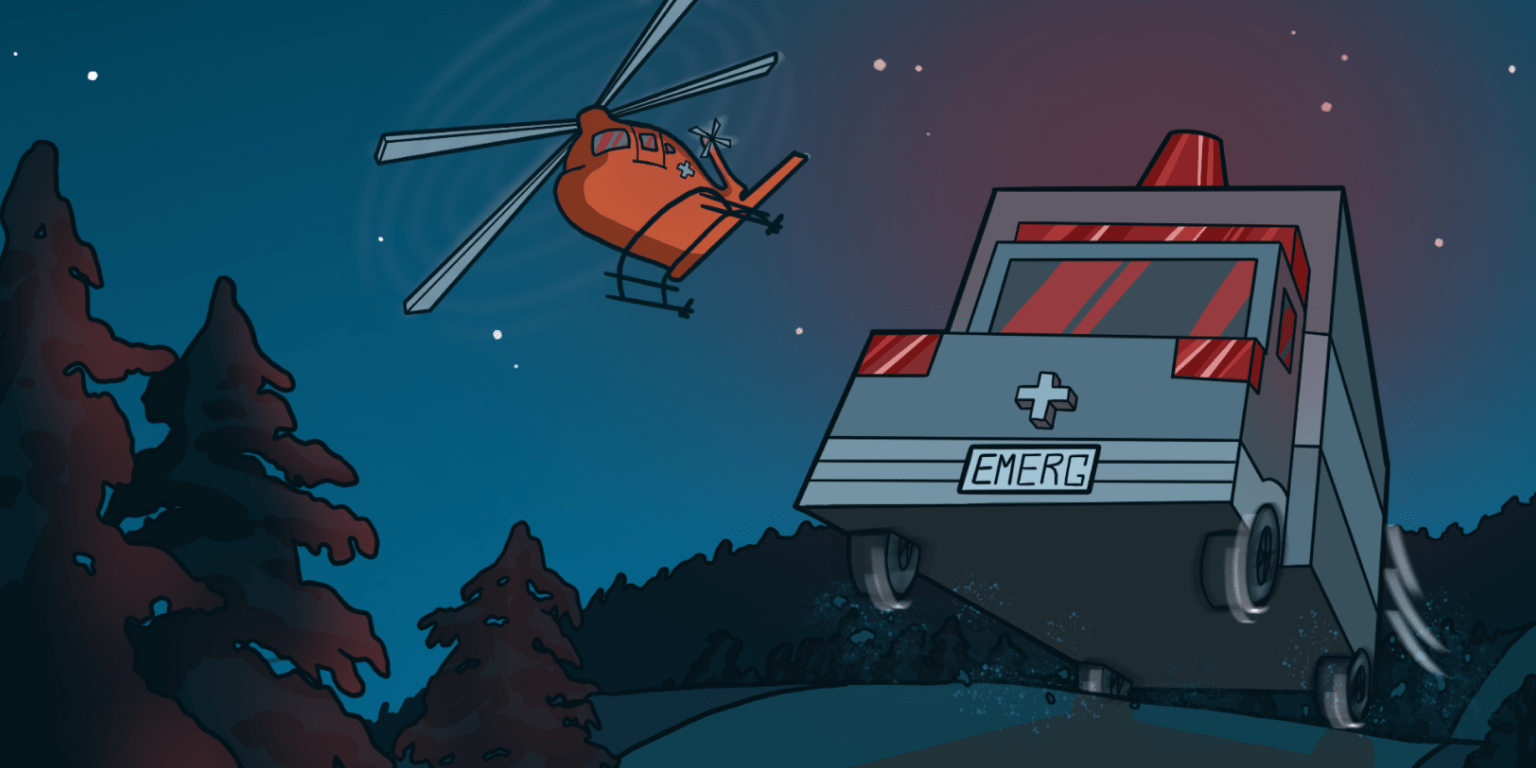
Bridging this gap in access to timely trauma cases is the mission of Ornge, Ontario’s air ambulance service. Ornge provides rapid air and land medical transport for critically ill or injured patients across the province. Working with Ornge gave Dr. Nolan firsthand insight into how delays in trauma care occur. In one instance, Ornge was dispatched to transport an unconscious motorcyclist on the side of the highway who was struggling to breathe. After takeoff to retrieve the patient, on-site paramedics cancelled the helicopter, deeming it unnecessary. Hours later, Ornge was called again for the same patient as a transfer from a community hospital. The patient was now unstable and severely injured. “By then, you’re well outside of that first hour,” he said. Unfortunately, the patient arrived at the trauma centre too late and died. This case highlights how miscommunication and decentralized decision-making can contribute to preventable delays in trauma care.
Such experiences encouraged him to investigate and optimize the logistics of transport medicine. Although delays in prehospital trauma care are widely acknowledged, there is limited systematic data documenting how often they occur and their consequences. Dr. Nolan and colleagues conducted an analysis of air ambulance transports to identify common sources of delay—including inclement weather, waiting for documentation, delay to intubate, among others.1 His ongoing work aims to document these patterns and help systems better identify patients that require expedited transportation to trauma centres.
Dr. Nolan is also working to improve trauma care on the ground, not just in the air. The Trauma Black Box is an educational quality improvement tool that allows for the capturing of every aspect of trauma resuscitation, including patient data and the procedural environment, allowing teams to review what flowed well, where delays happened, and how future performance can improve.2 Dr. Nolan describes this technology as “reviewing game footage after a big sports game. It’s not for blame, but rather for learning.”
Beyond improving logistics and team performance, Dr. Nolan’s research also centres around how and when blood is given to trauma patients experiencing severe bleeding. Prior to World War I, bleeding patients were given intravenous saline. While this temporarily restored blood pressure, saline is insufficient given its lack of oxygen and clotting factors. During the war, battlefield surgeons realized that delivery of whole blood—containing red blood cells, plasma, and platelets—is more effective, as it has crucial features that saline lacks.3 By the 1960s and 1970s, however, trauma care shifted to component therapy, in which donated blood is separated into its individual parts—red blood cells, plasma, and platelets. With this method, a single donation could help multiple patients—for example, someone with chronic anemia (low red blood cell count) could use a transfusion of just red blood cells, without the other components. This approach improved safety, efficiency, and resource management, reducing adverse reactions by moving away from the one-size-fits-all model of whole blood transfusion.3
Although component therapy has become the most popular method of blood transfusion, a 2015 study suggested that trauma patients did better when given blood products in a 1:1:1 ratio (plasma:platelets:red blood cells), effectively recreating whole blood.4 More recent advances, like leukoreduction filters that safely remove white blood cells—which are responsible for many transfusion adverse reactions, including fevers, inflammation and immune complications—have made whole blood transfusions safer. It still remains uncertain which approach, component therapy or the new methods of whole blood transfusion, offers the best outcomes in trauma care.
These uncertainties prompted the development of the Study of Whole Blood in Frontline Trauma Canada (SWiFT), a national prehospital transfusion trial, co-led by Dr. Nolan, that investigates the efficacy of whole blood transfusion for patients experiencing severe bleeding.5 The study is currently recruiting patients and is still ongoing to develop conclusive results, but Dr. Nolan notes that while component therapy may be advantageous in classical care settings, whole blood transfusion has many potential advantages in high-pressure settings. “In a helicopter, you have two paramedics, a critically injured patient, and a lot going on,” he says. “Being able to administer a single bag [of whole blood], as opposed to two or three bags [separated into components], simplifies a lot.” In a trauma bay with 30 people and endless resources, these logistics aren’t as daunting, but in the air, where space, time, and hands are limited, simplicity matters.
Dr. Nolan is pursuing multiple avenues to make great strides in trauma care. He is sustained in large part by his gratitude and the opportunity to work three different jobs that he loves: emergency shifts, trauma team leadership, and transport medicine. Each demand something different but still reinforce the others. “Emergency medicine is such a team sport,” he says. “There’s not that hierarchy that sometimes exists within medicine, everyone’s kind of just moving and doing what they can for the best of patients.” Whether he is at the bedside, in the trauma bay, or guiding paramedics from hundreds of kilometres away, his philosophy is grounded in urgency: acting early, decisively, and doing everything possible to keep patients within the critical window of timely care is essential to ensuring better outcomes in trauma care.
References:
- Nolan B, Haas B, Tien H, et al. Causes of Delay During Interfacility Transports of Injured Patients Transported by Air Ambulance. Prehosp Emerg Care. 2019;24(5):625-33. doi:10.1080/10903127.2019.1683662
- Nolan B, Hicks CM, Petrosoniak A, et al. Pushing boundaries of video review in trauma: using comprehensive data to improve the safety of trauma care. Trauma Surgery & Acute Care Open. 2020;5(1):e000510. doi: 10.1136/tsaco-2020-000510
- Nolan B, Schellenberg M, Ball CG, et al. Evidence Based Reviews in Surgery: a critical appraisal of whole blood resuscitation in injured patients. Canadian Journal of Surgery. 2025; 68(3):E271-3. doi: 10.1503/cjs.009924
- Holcomb JB, Tilley BC, Baraniuk S, et al. Transfusion of Plasma, Platelets, and Red Blood Cells in a 1:1:1 vs a 1:1:2 Ratio and Mortality in Patients With Severe Trauma: The PROPPR Randomized Clinical Trial. JAMA. 2015;313(5):471-82. doi:10.1001/jama.2015.12
- Antonacci G, Williams A, Smith J, et al. Study of Whole blood in Frontline Trauma (SWiFT): implementation study protocol. BMJ open. 2023;14(2):e078953. doi:10.1136/bmjopen-2023-078953
 IMS Magazine
You must be logged in to post a comment.