
By Gharaza Nasir and Sabeeka Malik
Graphic design by Vicky Lin
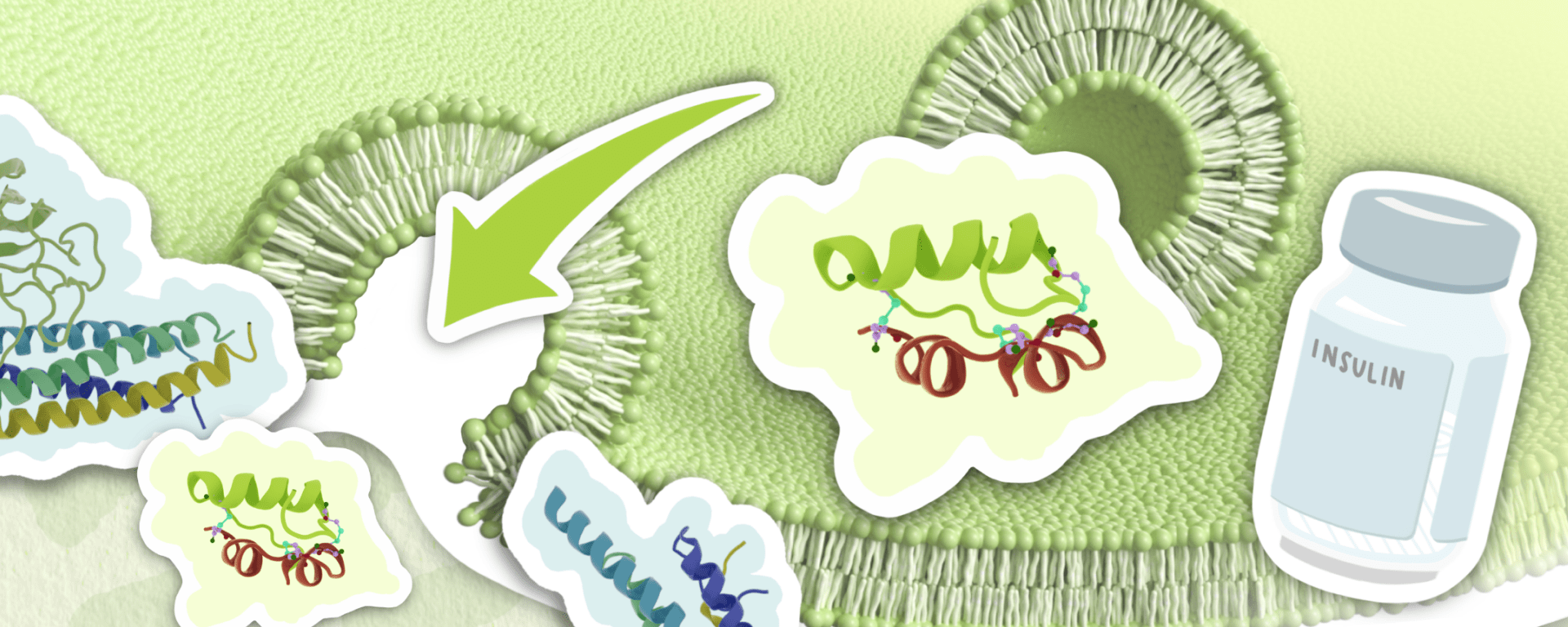
In 2024, approximately 3.9 million Canadians lived with diagnosed diabetes, and 260,000 new cases are diagnosed each year, posing a significant burden on the healthcare system.1 We typically associate diabetes with concepts like blood sugar, diet, lifestyle, and insulin. Although these are relevant, these associations overlook the intricate cellular choreography underlying metabolic conditions. Hidden from view are the pancreatic islet cells, or beta cells, which secrete tiny vesicles carrying insulin, a critical regulator of blood glucose.
In healthy individuals, after a meal, glucose levels rise in the bloodstream, which signals beta cells to release insulin from these vesicles. For insulin to perform its role effectively, these vesicles must undergo a precise sequence of events: docking at the cell membrane, fusing with it, and releasing their contents into the bloodstream.2 Upon successful release, insulin promotes the uptake of glucose by cells, enabling the cells to use the glucose for energy. However, in individuals with type 1 diabetes (T1D), the body destroys its own beta cells, resulting in little to no insulin release. In type 2 diabetes (T2D), individuals develop a resistance to insulin. Both forms of diabetes lead to dysregulated blood glucose, or high blood sugar, which can lead to vascular vessel damage and further health complications, such as heart disease and kidney disease.1

MD, FRCP(C)
Senior Scientist, Toronto General Hospital Research Institute, Professor in the Departments of Physiology and Medicine
Photo credit: Dr. Gaisano
Despite a strong understanding of why diabetes develops, the precise mechanism by which beta cells release insulin remained elusive. Early in his career as a clinician-scientist, Dr. Herbert Gaisano set out to address this gap by studying the mechanisms of insulin release in pancreatic beta cells. Dr. Gaisano is a Professor in the Departments of Physiology and Medicine at the University of Toronto, as well as a Senior Scientist at the Toronto General Hospital Research Institute. When he began working at the University of Toronto in 1991, soluble-N-ethylmaledimide-sensitive factor attachment protein receptors (SNARE) proteins were a novel concept.
SNARE proteins are a family of small membrane anchored proteins responsible for fusing vesicles with target membranes.3 These proteins act as the cell’s “molecular machinery,” enabling the delivery of materials from one part of the cell to another called vesicular transport, and when delivered outside of the cell, this is called “exocytosis.”3 SNARE proteins were first discovered in the context of synaptic vesicle fusion in the nervous system. 3-5 Dr. Gaisano set out to characterize SNARE proteins in the realm of metabolic health in hopes of unveiling novel therapeutic targets.
Dr. Gaisano’s early work established the role of SNARE proteins in insulin secretion. His earliest contributions in the field highlighted the presence of neuronal SNARE proteins in beta cells.
Using known neuronal SNARE protein antibodies for western blotting and immunohistochemistry, Dr. Gaisano and his team showed the presence of SNARE proteins in the pancreatic beta cell.6,7 They were then able to confirm the localization of SNARE proteins on the plasma membrane and cytosolic vesicles, specifically on insulin granules, using immunofluorescence confocal microscopy, live-cell imaging, and electron microscopy.6,7 This and subsequent similar work defined the molecular framework for insulin exocytosis and secretion defects and revealed that insulin release requires the same fusion machinery as the brain.6-9
After establishing the role of SNARE proteins in insulin release, Dr. Gaisano sought to uncover their involvement in diabetes pathogenesis. Pancreatic islet beta cells isolated from a diabetic rat model were found to have lower levels of SNARE proteins when compared to the wild type.8 When diabetic rats were treated with phlorizin, a drug that lowers blood glucose, they saw an increase in beta-cell SNARE protein levels. 8 This suggests that hyperglycemic states, common in individuals with T2D, disrupts proper SNARE protein function. These findings directly implicated SNARE proteins in the pathogenesis of diabetes and reframed the field to include cellular defects, like in exocytosis, as a root cause of metabolic diseases, extending beyond the traditional focus on insulin production and resistance.
Dr. Gaisano’s monumental contributions to the field led to a series of continued research, building on his work with SNARE proteins. With increased resources and advances in imaging technology, scientists were able to visualize this molecular machinery in action. In 2005, Dr. Gaisano and his team used live imaging to track the movement of single insulin granules towards the edge of beta cells, their attachment to the membrane, and the release of their contents in beta cells from diabetic and non-diabetic donors.9 The work showed that insulin release is not random, but a highly regulated process that is disrupted in individuals with diabetes. 9 Another pioneering discovery of Dr. Gaisano is how SNARE proteins contribute to insulin exocytosis by their interactions with ion channels.10 SNARE proteins may act as regulatory “brakes” on insulin exocytosis by their interactions with other novel proteins, potentially offering novel therapeutic targets for T2D.11
If there is one thing we can learn from Dr. Gaisano, it is the importance of having the courage to look where no one else is—digging deeper, beyond the surface of the disease. It is important to investigate the underlying biology to find the mechanistic answers behind complex systems. He encourages students to continuously learn new techniques and apply them beyond what might seem obvious. Dr. Gaisano’s work has reshaped our understanding of metabolic diseases and specifically in the context of diabetes care for patients. By shifting the research perspective beyond insulin resistance to the biology of insulin release, his work has shown that metabolic health depends not only on how the body responds to insulin, but also on whether it can be delivered effectively. His work serves as a reminder to young scientists to challenge conventions, ask difficult questions, remain curious, and explore novel ideas.
References
- Government of Canada. Diabetes in Canada: An interactive report on key statistics [Internet]. Ottawa: Government of Canada; 2025 [cited 2026 Mar 3]. Available from: https://health-infobase.canada.ca/diabetes/
- Fu Z, Gilbert ER, Liu D. Regulation of Insulin Synthesis and Secretion and Pancreatic Beta-Cell Dysfunction in Diabetes. Curr Diabetes Rev. 2013 Jan 1;9(1):25–53.
- Söllner T, Bennett MK, Whiteheart SW, et al. A protein assembly-disassembly pathway in vitro that may correspond to sequential steps of synaptic vesicle docking, activation, and fusion. Cell. 1993 Nov;75(3):409-418.
- Söllner T, Whiteheart SW, Brunner M, et al. SNAP receptors implicated in vesicle targeting and fusion. Nature. 1993 Mar;362(6418):318-24.
- Sudhof TC. The synaptic vesicle cycle. Annu Rev Neurosci. 2004;27:509-47.
- Wheeler MB, Sheu L, Ghai M, et al. Characterization of SNARE protein expression in beta cell lines and pancreatic islets. Endocrinology. 1996 Apr;137(4):1340-8.
- Gaisano HY, Ghai M, Malkus PN, et al. Distinct cellular locations of the syntaxin family of proteins in rat pancreatic acinar cells. Mol Biol Cell. 1996 Dec; 7(12):2019-27.
- Gaisano HY, Ostenson CG, Sheu L, et al. Abnormal Expression of Pancreatic Islet Exocytotic Soluble N-Ethylmaleimide-Sensitive Factor Attachment Protein Receptors in Goto-Kakizaki Rats Is Partially Restored by Phlorizin Treatment and Accentuated by High Glucose Treatment. Endocrinology. 2002 Nov;143(11):4218–4226.
- Kwan EP, Gaisano HY. Glucagon-like peptide 1 regulates sequential and compound exocytosis in pancreatic islet beta-cells. Diabetes. 2005 Sep;54(9):2734-43.
- Leung YM, Kwan EP, Ng B, Kang Y, Gaisano HY SNAREing voltage-gated K+ and ATP-sensitive K+ channels: tuning beta-cell excitability with syntaxin-1A and other exocytotic proteins. Endocr Rev. 2007 Oct;28(6):653-63.
- Xie L, Kang F, Qin T, et al. Septin5 deletion enhances β-cell exocytosis by releasing microtubule-tethered insulin granules onto plasma membrane. Nat Commun. 2025 Mar; 16:2725.


You must be logged in to post a comment.