
by Emily Forster and Sonika Kumari
Graphic design by Ravneet Jaura
While there’s no right time to have kids, deciding if and when to do so can be a challenge—and for many, it’s also a luxury. Imagine being asked to decide within days whether to preserve fertility before chemotherapy, or trying to plan a pregnancy during the unrelenting pace of medical training. Both situations carry quiet urgency. Fertility preservation offers options, but only if people are informed early enough and can access care equitably.
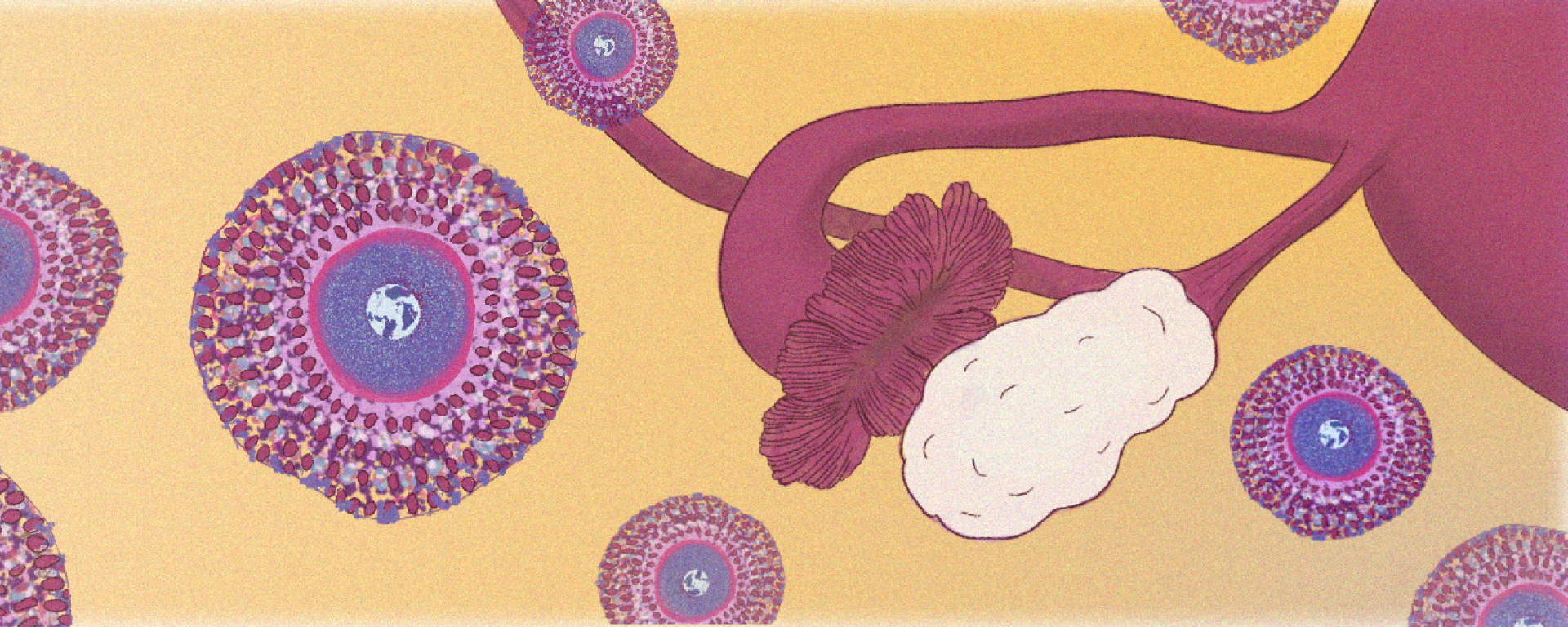
Fertility preservation is an umbrella term for different medical techniques that save eggs, sperm, or other reproductive tissues to help someone have a child in the future. For males, freezing sperm is rather easy, as samples can simply be frozen and then stored indefinitely for later use. Females, however, need to go through a more complicated process, as egg freezing involves up to two weeks of daily hormonal injections and multiple clinic appointments, followed by a minor surgical procedure. Collected eggs are then frozen at ultra-cold temperatures for long-term storage, known as cryopreservation. Eggs can also be fertilized with partner or donor sperm before storage, a process known as embryo cryopreservation. While these techniques offer excellent options, many people first encounter them during moments of crisis, with limited time to understand and access them.
For cancer patients, time is often the scarcest resource of all. Cancer therapy can damage sperm or eggs and can deplete ovarian reserve,1 putting the patient’s fertility at risk. Many cancer patients cannot delay treatment for egg freezing or may be too young to provide eggs. A promising alternative is called Ovarian Tissue Cryopreservation (OTC), a procedure in which thin sections of ovary are laparoscopically removed and then cryopreserved. These tissue fragments can later be re-implanted to restore fertility and hormonal function.2
In episode #135 of Raw Talk Podcast, Dr. Jennia Michaeli, an oncofertility specialist and clinician-scientist at Mount Sinai Fertility, shared, “People spend the rest of their lives as cancer survivors, and we want to make sure that they maintain their quality of life and are able to accomplish their life goals. And for many people, having children is one of the most fundamental life goals.” Yet in the shock and urgency of a cancer diagnosis, fertility may not be top of mind—including for the treating physician. Patients cannot choose options they are never offered; this makes early, standardized fertility counseling not just a clinical courtesy, but an equity issue. Counseling must also be culturally respectful and trauma-informed, recognizing that beliefs about reproduction and medical decision-making differ across communities.
Despite OTC’s promise, access remains unequal: laparoscopic surgery can be done in most medical settings, but processing and storage require specialized facilities. To improve access, tissue samples can be transported to centralized cryobanks with appropriate infrastructure.3 Dr. Michaeli described this model as “the patient stays; the tissue moves”, a slogan she heard originally from international colleagues. In practice, however, this system depends on awareness, coordination, and funding—all still lacking.
Fertility preservation also intersects with longstanding health inequities. In Ontario, lesser-known fertility preservation methods like OTC remain completely unfunded, which is often an insurmountable financial barrier to access. An OTC procedure alone costs approximately $12,000 USD,4 which does not even include the costs for sample storage or reimplantation when pregnancy is desired. These gaps disproportionately affect patients with lower incomes, those in rural communities, and those navigating multiple systemic barriers to care, widening existing disparities in cancer outcomes and access to specialized care.5 Ensuring equitable fertility preservation therefore demands culturally competent communication, dedicated navigation resources, and funding structures that do not disadvantage already marginalized populations. Expanding fertility preservation options means little if access remains limited to those in most need.
These inequities extend beyond oncology, into training of future physicians, professionals, and more. Even without illness, fertility preservation decisions weigh heavily on young people in the early stages of demanding careers, particularly in medicine. Population-based data from Ontario show physicians’ median age at first childbirth is 32, compared with 27 among non-physicians.6
In episode #135 of Raw Talk Podcast, Dr. Lauren Pickel, a first-year urology resident at the University of Toronto, shared that while in medical school she did not remember “any teaching about family planning, fertility planning, and how that might intersect with a medical career.” This gap is common, as less than 8% of female physicians are educated on the risks of delaying pregnancy, such as infertility, miscarriage, or pregnancy complications.7 This shortcoming affects personal choices as well as career trajectories, including specialty selection, geographic placement, and long-term seniority status. Although female representation in medicine has been rising in Canada, it remains disproportionately low in leadership positions and in the surgical specialty,8,9 highlighting the importance of improved workplace family planning policies and education.
On a lighter note, in episode #135, Dr. Nirojini Sivachandran, a retinal surgeon and clinician-scientist at the Toronto Retina Institute, who had two children during residency, described how institutional support can make a difference: “I had the most amazing program director who was incredibly supportive, and I think that truly helped me carry through the program.” Stories like hers highlight how workplace culture and policy shape reproductive choices. Improving family planning policies and education in the workplace could significantly better the quality of life for many physicians and their families.
Across oncology clinics and medical schools, the same gap persists: fertility preservation exists, but education and access lag behind. When people can see the options available to them and the steps they need to take, decisions feel less like emergencies and more like care. Fertility care must begin with early standardized counseling and sustained public funding. Reproductive choice must be protected as a core component of equitable care, not just a privilege.
We would like to acknowledge the efforts and ideas of the episode #135 team. Sonika Kumari and Julia Wong were Show Hosts and Tesam Ahmed was our Content Creator. Angela Dela Cruz was the Audio Editor and Nicole Chu is our Executive Producer.
To learn more about why fertility preservation must be a health system priority, we invite you to listen to episode #135 of Raw Talk Podcast, titled #135: Understanding Fertility and Reproductive Health.
References
1. Vassilakopoulou M, Boostandoost E, Papaxoinis G, et al. Anticancer treatment and fertility: Effect of therapeutic modalities on reproductive system and functions. Critical Reviews in Oncology/Hematology 2016;97:328–334; doi: 10.1016/j.critrevonc.2015.08.002.
2. Diaz-Garcia C, Domingo J, Garcia-Velasco JA, et al. Oocyte vitrification versus ovarian cortex transplantation in fertility preservation for adult women undergoing gonadotoxic treatments: a prospective cohort study. Fertility and Sterility 2018;109(3):478-485.e2; doi: 10.1016/j.fertnstert.2017.11.018.
3. Michaeli J, Erb M, Savic M, et al. Fertility preservation by ovarian tissue transportation and centralized cryobanking for a 20-year-old woman with Hodgkin lymphoma. CMAJ 2025;197(39):E1307–E1310; doi: 10.1503/cmaj.250519.
4. Levine J, Canada A, Stern CJ. Fertility Preservation in Adolescents and Young Adults With Cancer. JCO 2010;28(32):4831–4841; doi: 10.1200/JCO.2009.22.8312.
5. Peipert BJ, Potapragada NR, Lantos PM, et al. A Geospatial Analysis of Disparities in Access to Oncofertility Services. JAMA Oncol 2023;9(10):1364; doi: 10.1001/jamaoncol.2023.2780.
6. Cusimano MC, Baxter NN, Sutradhar R, et al. Delay of Pregnancy Among Physicians vs Nonphysicians. JAMA Intern Med 2021;181(7):905; doi: 10.1001/jamainternmed.2021.1635.
7. Lai K, Garvey EM, Velazco CS, et al. High Infertility Rates and Pregnancy Complications in Female Physicians Indicate a Need for Culture Change. Annals of Surgery 2023;277(3):367–372; doi: 10.1097/SLA.0000000000005724.
8. Pickel L, Sivachandran N. Gender representation in Canadian surgical leadership and medical faculties: a cross-sectional study. BMC Med Educ 2024;24(1):667; doi: 10.1186/s12909-024-05641-6.
9. Pickel L, Sivachandran N. Gender trends in Canadian medicine and surgery: the past 30 years. BMC Med Educ 2024;24(1):100; doi: 10.1186/s12909-024-05071-4.

