
by Carmen K. Chan
Graphic design by Josip Petrusa
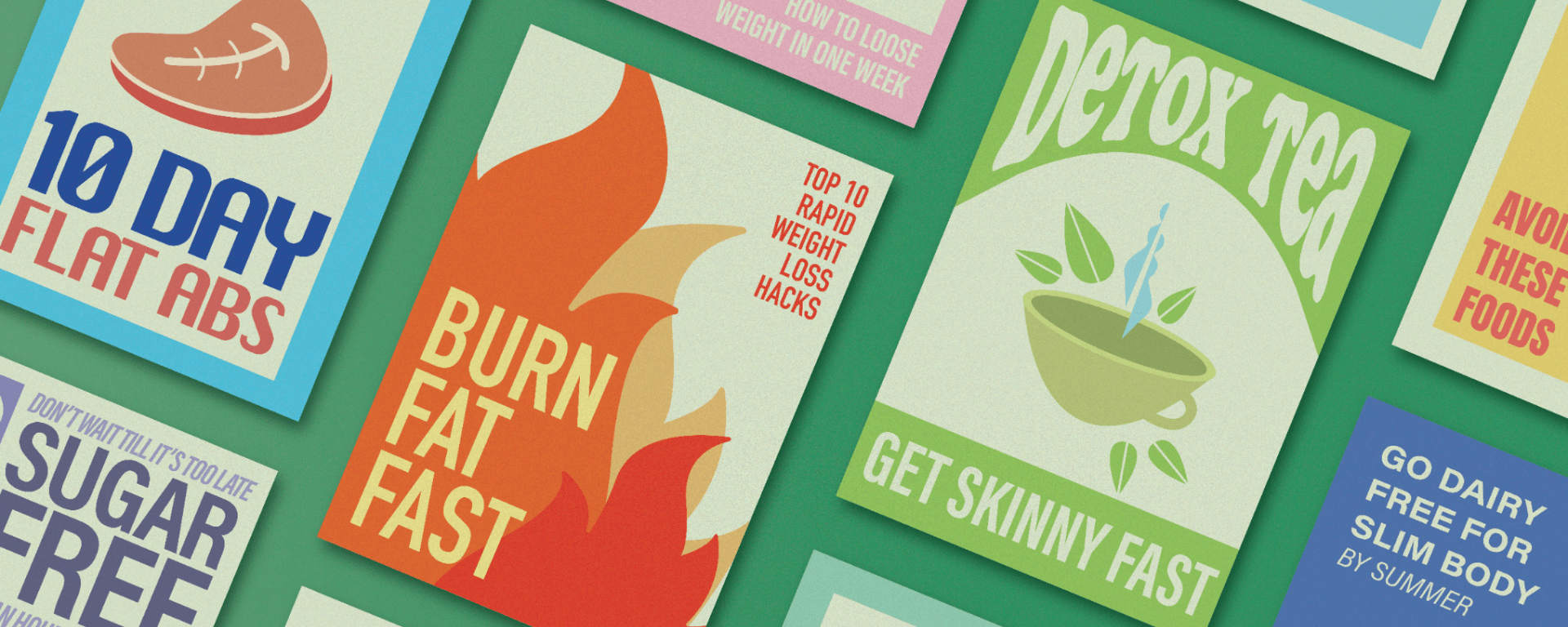
Brightly coloured magazines lined the checkout aisles at Walmart, each featuring an airbrushed celebrity coaxing me to uncover the diet secrets inside: “GET-SLIM DETOX TEA” and “BURN FAT FAST”. The cultural narrative is clear: quick-fix diets promise rapid, effortless weight loss.
Despite the popularity of these diets, the prevalence of obesity continues to increase at an alarming rate worldwide. In Canada, more than two-thirds (68.3%) of adults were classified as overweight or having obesity based on body-mass index in 2024, a substantial increase from 60.4% in 2017.1 Obesity contributes to mortality through increased risk of type 2 diabetes (T2D), cardiovascular disease, and some cancers.2 So why do these empty promises continue to appeal to us?
“Fad diets” are trendy eating patterns intended for rapid weight loss or other health benefits, such as improving blood sugar, blood pressure, and cholesterol. Despite differing rules, most share the same physiological mechanism: reducing caloric intake so the body uses more energy than it consumes. The high-fat/low-carbohydrate ketogenic (“keto”) diet promotes satiety through increased fat intake, helping people sustain a caloric deficit. At the other end, low-fat diets can also lead to weight loss, as fat is the most energy-dense macronutrient, although long-term efficacy is often limited.3 Detoxes are even more restrictive, eliminating entire food groups or limiting intake to liquids. Intermittent fasting alternates between periods of eating and fasting that can last from hours to days, thereby reducing opportunities to consume calories. Notably, reduced caloric intake is also a primary driver of weight loss with Ozempic and Wegovy, glucagon-like peptide-1 (GLP-1) receptor agonists that have risen in popularity over the last several years. Collectively, these approaches highlight that weight loss depends on a negative energy balance.
Short-term studies on fad diets have shown meaningful health benefits. Compared with the Mediterranean diet—an established, evidence-based diet emphasizing plant-based foods and healthy fats—the keto diet or intermittent fasting for three months reduced more body weight than the Mediterranean diet in adults with obesity.4 Other studies have reported additional metabolic benefits associated with intermittent fasting, including reduced fat mass, blood sugar, and blood fat levels.5 Likewise, a three-month keto diet was as effective as the Mediterranean diet at improving blood sugar in adults with prediabetes or T2D.6
However, long-term safety and efficacy data on fad diets are limited. In adults with T2D, a six-month calorie-unrestricted high-fat/low-carbohydrate diet was more effective at reducing weight and improving blood sugar than a low-fat/high-carbohydrate diet, but improvements were not sustained three months after stopping the diet.7 Similarly, a meta-analysis of 11 randomized controlled trials comparing the keto diet to control diets showed no significant differences in body weight or blood sugar in adults with T2D, and only one study extended follow-up to two years.8 Additional concerns include nutritional deficiencies and hormonal disruption,9 which may make some fad diets unsafe during pregnancy and for individuals with co-morbidities10. Despite these potential risks and data gaps, fad diets remain widely promoted and appealing to us.
The personal appeal of fad diets stems from their simplicity. Obesity is a complex, multi-factorial disease shaped by an interplay of biology, genetics, and environment. Yet persistent messaging to “just eat less and move more” largely attributes responsibility on individual willpower. Many may be motivated to change their diet to regain control. In a culture of endless choices, the rigid rules of fad diets are particularly alluring, reducing decision fatigue and restoring that sense of control. Rapid early weight loss, largely from water loss rather than fat, reinforces adherence to fad diets. This creates the impression that the diet is working before any meaningful fat loss occurs. However, this simplicity warrants caution as the rigid dietary rules and rapid weight changes may exacerbate disordered eating. Specifically, individuals who engage in fad diets were found to have an increased risk of depression, body dissatisfaction, and disordered eating behaviours.11
Beyond personal motivations, the appeal of fad diets is amplified by systemic and social barriers. Weight bias can appear through exclusionary design (i.e., equipment and furniture that inadequately accommodate diverse body sizes) and harmful stereotypes in schools, workplaces, media, and healthcare.12 Notably, individuals with obesity reported increased discrimination in Canadian healthcare settings.13 Currently, Alberta is the only Canadian province that recognizes obesity as a chronic disease,14 which may contribute to limited public coverage for evidence-based treatments. The lack of recognition combined with weight bias in healthcare settings can delay access to proper care, despite obesity increasing risk for many chronic diseases.
Additionally, socioeconomic status may limit access to healthy foods through the creation of “food deserts”. Communities experiencing poverty, lower education level, high unemployment rates, and limited transportation access were found to have an increased likelihood of becoming food deserts,15 which was associated with higher obesity risk.16 This structural challenge is compounded by a profit-driven food industry that prioritizes highly palatable, calorically dense products. Sociocultural ideals of thinness, once reflected in pervasive diet tips in print media and now in the normalization of diet culture on social media, further amplify anecdotal advice without scientific support. With evidence-based options limited and healthy foods difficult to afford, many individuals may turn to quick, accessible strategies such as fad diets to navigate widespread weight bias.
Glossy magazines promising “FLAT ABS IN 10 DAYS” oversimplify complex health issues and promote quick-fix solutions. This simplicity is precisely what drives the appeal of fad diets, which is reinforced by our systems and social norms. But our health and wellbeing are not fads. Moving toward sustainable, evidence-based approaches while addressing systemic issues will not be a quick-fix, but it is the only path to lasting health for all.
References
1. Statistics Canada. Overweight and obesity based on measured body-mass index, by age group and sex 2025. doi:10.25318/1310037301-ENG.
2. Abdelaal M, le Roux CW, Docherty NG. Morbidity and mortality associated with obesity. Ann. Transl. Med. 2017;5:161. doi:10.21037/atm.2017.03.107.
3. Tobias DK, Chen M, Manson JE, et al. Effect of low-fat diet interventions versus other diet interventions on long-term weight change in adults: a systematic review and meta-analysis. Lancet Diabetes Endocrinol. 2015;3:968–79. doi:10.1016/S2213-8587(15)00367-8.
4. Martínez-Montoro JI, Bandera B, Gutiérrez-Bedmar M, et al. Effect of a ketogenic diet, time-restricted eating, or alternate-day fasting on weight loss in adults with obesity: a randomized clinical trial. BMC Med. 2025;23:368. doi:10.1186/s12916-025-04182-z.
5. He M, Wang J, Liang Q, et al. Time-restricted eating with or without low-carbohydrate diet reduces visceral fat and improves metabolic syndrome: A randomized trial. Cell Rep. Med. 2022;3:100777. doi:10.1016/j.xcrm.2022.100777.
6. Gardner CD, Landry MJ, Perelman D, et al. Effect of a ketogenic diet versus Mediterranean diet on glycated hemoglobin in individuals with prediabetes and type 2 diabetes mellitus: The interventional Keto-Med randomized crossover trial. Am. J. Clin. Nutr. 2022;116:640–52. doi:10.1093/ajcn/nqac154.
7. Hansen CD, Gram-Kampmann E-M, Hansen JK, et al. Effect of Calorie-Unrestricted Low-Carbohydrate, High-Fat Diet Versus High-Carbohydrate, Low-Fat Diet on Type 2 Diabetes and Nonalcoholic Fatty Liver Disease : A Randomized Controlled Trial. Ann. Intern. Med. 2023;176:10–21. doi:10.7326/M22-1787.
8. Choy KYC, Louie JCY. The effects of the ketogenic diet for the management of type 2 diabetes mellitus: A systematic review and meta-analysis of recent studies. Diabetes Metab. Syndr. Clin. Res. Rev. 2023;17:102905. doi:10.1016/j.dsx.2023.102905.
9. Tahreem A, Rakha A, Rabail R, et al. Fad Diets: Facts and Fiction. Front. Nutr. 2022;9:960922. doi:10.3389/fnut.2022.960922.
10. Daley SF, Masood W, Annamaraju P, et al. The Ketogenic Diet: Clinical Applications, Evidence-based Indications, and Implementation. StatPearls, Treasure Island (FL): StatPearls Publishing; 2025.
11. Burmeister J, Burmeister AK, Moening L, et al. Fad dieting and psychological well-being. Nutrition. 2026;142:112996. doi:10.1016/j.nut.2025.112996.
12. Recognizing & reducing weight bias. Obes. Can. n.d. https://obesitycanada.ca/for-patients/weight-bias/.
13. Gupta N, Bombak A, Foroughi I, et al. Discrimination in the health care system among higher-weight adults: evidence from a Canadian national cross-sectional survey. Health Promot. Chronic Dis. Prev. Can. Res. Policy Pract. 2020;40:329–35. doi:10.24095/hpcdp.40.11/12.01.
14. Alberta Declares March 4 as World Obesity Day, Recognizing Obesity as a Chronic Disease. Obes. Can. 2025. https://obesitycanada.ca/news/alberta-first-province-obesity-chronic-disease/.
15. Dutko P, Ploeg MV, Farrigan T. Characteristics and Influential Factors of Food Deserts. United States Department of Agriculture; 2012.
16. Chen D, Jaenicke EC, Volpe RJ. Food Environments and Obesity: Household Diet Expenditure Versus Food Deserts. Am. J. Public Health. 2016;106:881–8. doi:10.2105/AJPH.2016.303048.

