
By Jino Lim
Graphic design by Kevin Trinh
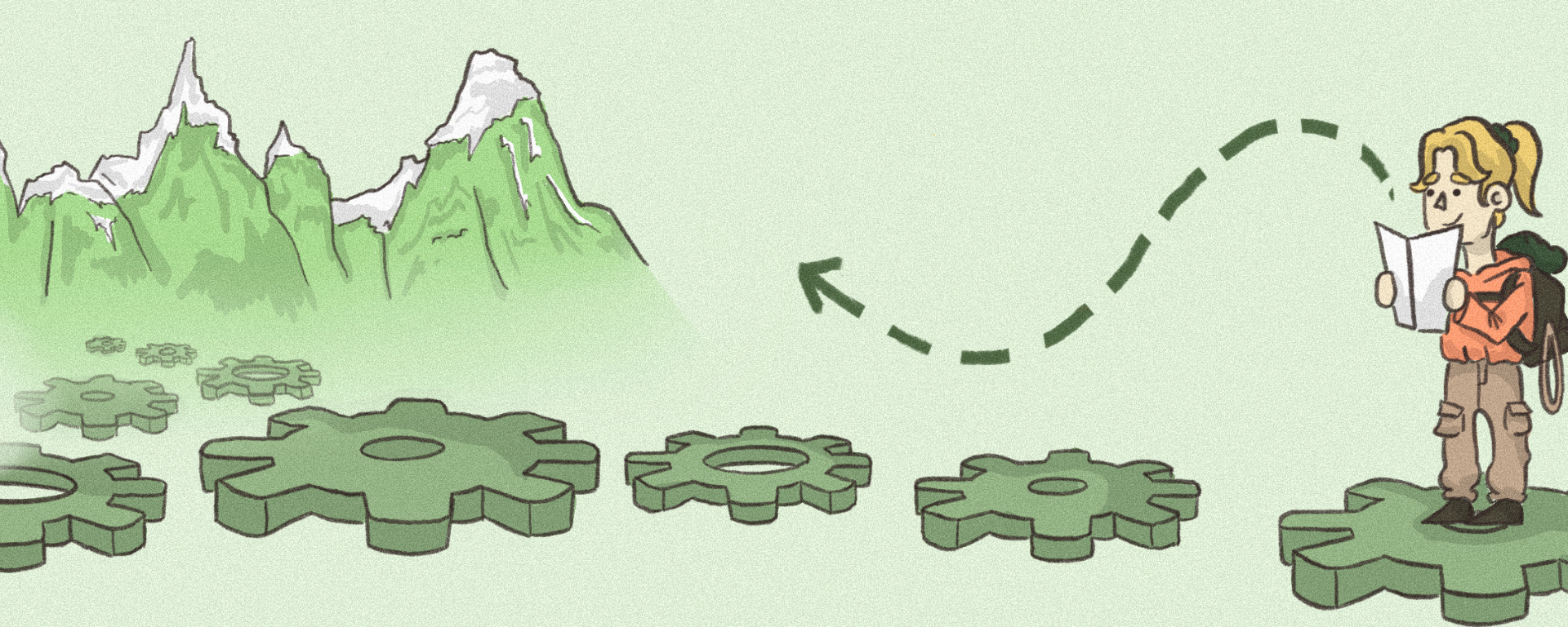
Valentina Tamayo Velasquez did not expect to find herself working in artificial intelligence. With a background in neuroscience and psychology, and no formal computer science training, the fifth-year PhD candidate entered graduate school drawn to clinical research, not algorithms. Today, however, Valentina investigates how artificial intelligence (AI) can be deployed safely in psychiatric care under the supervision of Drs. Bernard Le Foll and Andrea Waddell. Getting there meant stepping out of her comfort zone, asking questions, and navigating uncertainty.
Valentina entered the Institute of Medical Science (IMS) as a master’s student and transferred into the doctoral program in her second year. Her path brought together an “unlikely mix of interests and demanded skills,” she says. As an undergraduate at the University of Toronto, she studied neuroscience and psychology alongside a minor in French literature, an unexpected combination that Valentina attributes to “[wanting] to include a mix between science and language studies.”
Her willingness to learn beyond one discipline followed her into graduate school. Neuroscience and psychology overlapped in her undergraduate courses, but the components that piqued her interest were clinical rather than laboratory based. “My interest was always in the clinical side [of research],” she says. Even before the explosion of AI, her interest in clinical research drove her to choose a graduate project that employed machine learning to predict patient outcomes in health care. At the time, the utility of AI in a clinic was gaining attention, but its potential in mental health care specifically remained uncertain. Valentina knew that “there was a lot more to be learned in this field,” and she wanted to make an impact, whether big or small.
Her thesis focuses on the Predictive Risk Identification for Mental Health Events (PRIME) tool, a deep-learning early-warning system that uses routinely collected electronic medical record data to identify psychiatric patients at risk of adverse mental health events within 24 hours.1 It builds on similar approaches already established in general medicine. “In general health care, there’s been research on the integration of machine learning to leverage large amounts of data to predict adverse events, such as intensive care unit transfers or death,” she says, adding that “a lot of that can be predicted based on a patient’s deterioration within their stay at the hospital.” However, adverse events in psychiatric care extend beyond mortality and include aggression, violence, suicide attempts, self-harm, or harm to staff or other patients. Existing ML-driven models were not designed to anticipate these events. PRIME aims to fill that gap and is now being evaluated in a clinical feasibility trial.
For Valentina, entering this field meant moving beyond her prior training. “I don’t have any background in computer science, so it was all very daunting to me,” she explains. Her first years involved a steep learning curve. “You question everything you do because you want to do it right,” she says. Working with machine learning experts who focused on the ML algorithms required her to dive deep and understand and defend the model’s outputs without having directly designed it. “In grad school, I think everyone realizes how much more there is to learn, which pushes you to understand your research a bit more and defend the decisions behind the methods,” she says.
Over time and through trial and error, Valentina became more comfortable asking questions and drawing on the expertise of statisticians and machine learning researchers on her team. In doing so, she learned that graduate school is not just about mastering every technical detail, but about developing the judgment necessary to identify a project’s critical components and understand how each piece fits into the larger research question.
That shift toward greater confidence became apparent when she began sharing her work at conferences. While previous undergraduate poster presentations had once left her uncomfortable sharing her work, graduate school brought a growing sense of confidence in her research and her ability to communicate it. “It’s nice to be more confident in what you’re doing and understand the research more,” she says.
Her own experience of navigating machine learning without a computer science background now shapes how she presents her research to others. Valentina emphasizes the importance of transparency and education. Just as she needed the time to understand the tools underlying her research, clinicians need to understand how AI systems inform their decisions rather than simply being asked to trust their outputs. “You can’t just implement a tool and just say, ‘Here you go,'” she says. Concerns about accountability and the role of AI in the clinic are valid and addressing them requires going beyond how the model works. For Valentina, education is a critical part of implementation. “If you approach it with that education piece, it already goes a long way,” she says.
Her time at IMS has given her many experiences beyond her research. She chose the program for its breadth and its community, wanting a graduate experience that, like her research focus, reached beyond her area of expertise. “Some of my closest friends that I’ve made at IMS are not in the same field as me, and I wouldn’t have met them if it weren’t for IMS,” she says. Through IMS, Valentina became involved in community outreach, professional development, and science education.2 One of her most memorable experiences came through Pueblo Science, where she travelled to Indonesia to help teach undergraduate students and school teachers through hands-on STEM activities. “That was definitely one of the highlights of my life,” she says.
These experiences also strengthened Valentina’s passion for sharing science with others. “[In graduate school] you really learn how to target your science communication for a lot of different audiences,” she says. She remembers the excitement of presenting and seeing months of work become something she could share with others. “I really like feeling like I could help [students] in a constructive way,” she says, adding that “I want people to love science, so I think through teaching, [I] would like to motivate people [to] stay in science and go into science.”
As she approaches the later stages of her PhD, Valentina is still deciding exactly where her path will lead. Academia appeals to her for the two things she values most: continual learning and teaching. “You can always keep learning,” she says. Now, she hopes to pass on what she has learned to other students. As IMS’s new prospective student ambassador, she plans to share her experiences with students facing the same uncertainty she experienced five years ago and help them navigate their own paths in graduate school.
Valentina no longer expects herself to have every answer, and the questions that once made her second-guess her work have become a critical part of how she approaches science. Asking for help, collaborating with others, and being confident in her understanding of her own work form the foundation of her graduate school career. She learned that not knowing is not a sign of failure—it is simply where learning begins.
References
- Dolatabadi E, Tamayo Velasquez V, Dabboussi A, et al. Advancing Psychiatric Safety With the Predictive Risk Identification for Mental Health Events Tool: Retrospective Cohort Study. JMIR Ment Health. 2026 Feb 6;13. doi:10.2196/84318. PubMed PMID: 41649861.
- Student IMPACT Award Winners [Internet]. [cited 2026 Sep 14]. Available from: https://ims.utoronto.ca/student-impact-award-winners

