
By Selene Mitchell
Graphic design by Sarah Kung
Around age 47, a woman begins noticing subtle but unsettling changes. She forgets names mid-conversation, loses her train of thought during meetings, wakes hours before her alarm, and feels unusually on edge. At first, she assumes it is stress. Soon, she begins to wonder if something more serious is happening. Her doctor offers a different explanation: these are common experiences during the menopause transition, when changing hormone levels can affect cognitive function, mood, and sleep.
Menopause, the cessation of menstruation due to loss of ovarian follicles, is commonly associated with symptoms like hot flashes and mood swings. Even though roughly half of the world’s population will experience menopause, it remains severely understudied and underfunded. However, recent shifts in public attention, cultural advocacy, and policy change have contributed to a better understanding of the broader, lesser-known effects of menopause on women’s health.
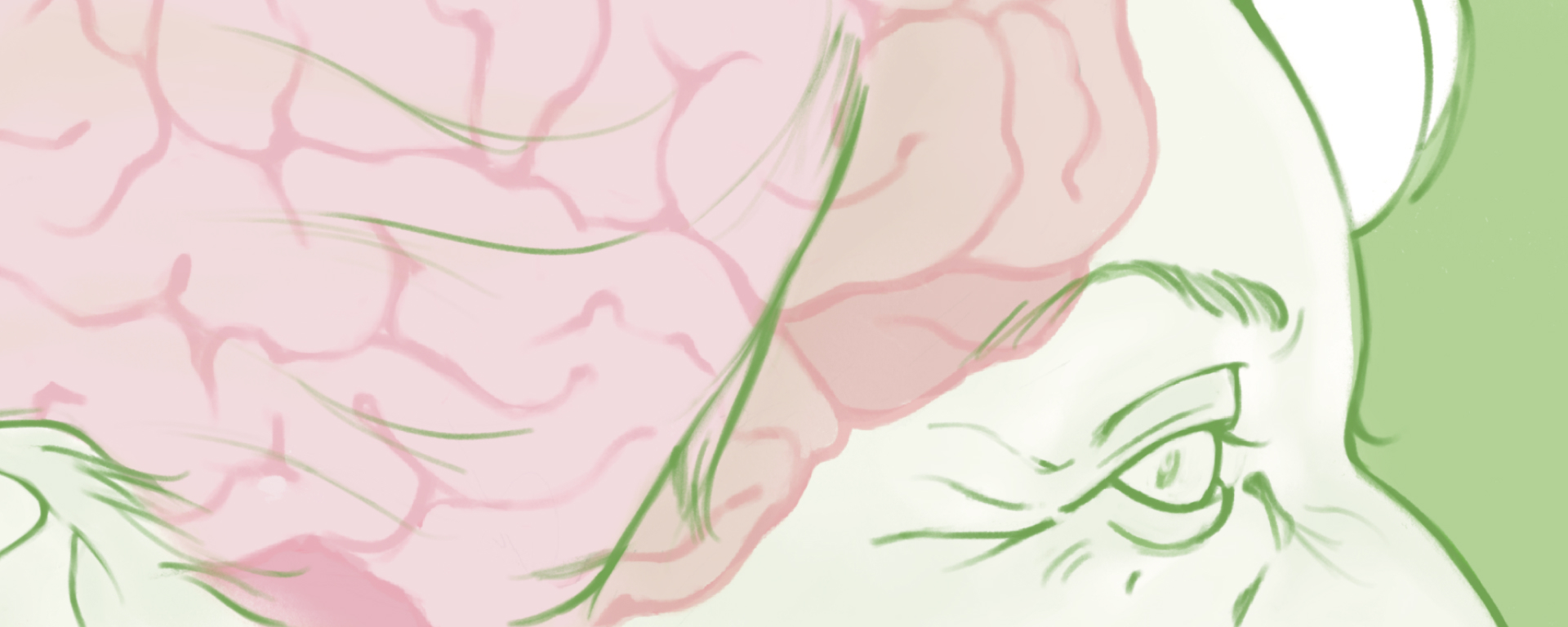
Today, research offers a deeper understanding of menopause that extends far beyond hot flashes. Scientists now describe menopause as a whole-brain transition, a period when hormonal changes can influence memory, attention, mood, and sleep.1 A recent review in Nature Reviews Psychology reframes menopause not as an ending but as a time of adaptation when the brain rewires itself for a new stage of life.2
Estradiol, one of the most active forms of estrogen, plays a key role in memory, learning, mood, and communication between brain cells.3 During perimenopause—the transition leading up to menopause—estradiol levels rise and fall unpredictably and gradually decline, affecting how the brain functions.
For many women, these changes manifest as “brain fog,” which encompasses trouble concentrating, difficulty finding words, or feeling mentally overwhelmed. Research suggests that nearly half of women in midlife experience cognitive changes during this period, often years before menopause officially occurs.4
Menopause is defined as 12 consecutive months without a menstrual period, whereas perimenopause can begin several years earlier, while periods may still be regular or irregular. Fortunately, cognitive changes associated with this transition appear to be temporary. Scientists emphasize that cognitive symptoms during perimenopause reflect the brain adapting to shifting hormone levels, not long-term damage or decline. One of the most encouraging findings is the brain’s apparent resilience through this transition. A four-year, longitudinal cohort study of 2,362 women aged 42-52 found that difficulties in areas like verbal learning and processing speed that begin in perimenopause were no longer evident once women reached post menopause. These results suggest that the cognitive effects of perimenopause may reflect a transient period of adjustment rather than permanent decline.5
Emerging research may explain this recovery. A neuroimaging study published in Scientific Reports finds that widespread changes in brain structure, connectivity, and energy metabolism occur during the menopausal transition. However, many of these changes stabilized after menopause. Following menopause, researchers found restored gray matter volume, increased mitochondrial energy production, and improved cognitive function.1 As hormone levels stabilize, the brain reorganizes its networks, forming new pathways that support memory, learning, and emotional regulation. Many women report clearer thinking and renewed focus.
These adaptations may extend beyond cognitive function to psychological well-being.6 Studies suggest that women’s perceptions of menopause often become more positive after experiencing the transition, with postmenopausal women describing greater feelings of confidence, freedom, and comfort with themselves. Rather than viewing menopause solely as a period of loss, some women describe it as an opportunity for personal growth and a new sense of identity.
Importantly, hormonal shifts during menopause can affect emotional well-being beyond cognition. Many women notice mood changes—feeling irritable, anxious, or unsettled. These effects can be especially pronounced in women with a history of depression.7 These changes highlight that menopause affects not only how the brain functions but also how women experience and regulate emotion.
Sleep problems are also common. Nearly half of women in midlife report sleep difficulties, particularly difficulty staying asleep and waking unexpectedly during the night.8 Because sleep is critical for memory and emotional regulation, these disruptions can worsen daytime symptoms. Importantly, sleep disturbances are not always associated with hot flashes, suggesting that changes in reproductive hormones during midlife may also contribute to sleep disruption.9
Menopause is a significant neurological, psychological, and social transition. Stress, caregiving responsibilities, past trauma, social support, and cultural attitudes about aging all shape how women experience this period.10 While it can be challenging, many women also describe midlife as a time of growth, marked by renewed purpose, greater confidence, and deeper self-understanding.11
Critically, there are evidence-based supports available that may ease the menopausal transition. For example, cognitive behavioural therapy (CBT) is an effective approach for managing menopausal symptoms. It can reduce stress, support emotional balance, improve sleep, and ease the distress associated with hot flashes. A 12-week CBT program tailored for menopause has been shown to improve overall well-being.12 Mindfulness-based practices may also reduce anxiety and support better sleep. A 2020 cross-sectional study finds that menopausal women participating in meditation reported reduced anger and irritability, as well as improvements in physical symptoms.13 Mindfulness shows promise for supporting emotional stability during hormonal changes.
Physical movement has also shown promise in relieving the symptoms of menopause. Beyond menopause, regular physical activity supports mental health, improves sleep, and reduces stress. These benefits also apply to people experiencing menopause. A 2025 systematic review and meta-analysis found that mind-body practices like yoga improve menopausal symptoms like poor sleep quality, anxiety, and depression.14 Movement represents a promising intervention to address the impacts of menopause. Together, approaches like physical activity, mindfulness, and CBT offer women practical ways to support their well-being as their brains and bodies adapt to this transition.
By viewing menopause as a brain transition, we can shift the narrative toward compassion, curiosity, and empowerment. This shift requires research that reflects women’s unique neurobiology, an area that has been historically overlooked. Midlife is not a decline. It is the beginning of a new chapter, one in which women can better understand their brains, trust their bodies, and navigate change with confidence.
References
- Mosconi L, Berti V, Dyke J, et al. Menopause impacts human brain structure, connectivity, energy metabolism, and amyloid-beta deposition. Sci Rep. 2021 Jun 9;11:10867. doi:10.1038/s41598-021-90084-y
- Thurston RC, Thomas HN, Castle AJ, et al. Menopause as a biological and psychological transition. Nat Rev Psychol. 2025 Aug;4(8):530–43. doi:10.1038/s44159-025-00463-9
- Luine VN. Estradiol and cognitive function: Past, present and future. Horm Behav. 2014 Sep;66(4):602–18. doi:10.1016/j.yhbeh.2014.08.011
- Goldstein JM. Menopause and memory: Know the facts. Harvard Health Publishing. November 3, 2021. https://www.health.harvard.edu/blog/menopause-and-memory-know-the-facts-202111032630
- Greendale GA, Huang MH, Wight RG, et al. Effects of the menopause transition and hormone use on cognitive performance in midlife women. Neurology. 2009 May 26;72(21):1850–7. doi:10.1212/WNL.0b013e3181a71193
- Morrison LA, Sievert LL, Brown DE, et al. Voices from the Hilo Women’s Health Study: Talking Story About Menopause. Health Care Women Int. 2014 May;35(5):529–48. doi:10.1080/07399332.2013.829067
- Freeman EW, Sammel MD, Boorman DW, et al. Longitudinal Pattern of Depressive Symptoms Around Natural Menopause. JAMA Psychiatry. 2014 Jan 1;71(1):36–43. doi:10.1001/jamapsychiatry.2013.2819
- Baker FC, de Zambotti M, Colrain IM, et al. Sleep problems during the menopausal transition: prevalence, impact, and management challenges. Nat Sci Sleep. 2018;10:73–95. doi:10.2147/NSS.S125807
- Carmona NE, Solomon NL, Adams KE. Sleep disturbance and menopause. Current Opinion in Obstetrics & Gynecology. 2025 Apr;37(2):75–82. doi:10.1097/GCO.0000000000001012
- Blackson EA, McCarthy C, Bell C, et al. Experiences of menopausal transition among populations exposed to chronic psychosocial stress in the United States: a scoping review. BMC Womens Health. 2024 Sep 4;24(1):487. doi:10.1186/s12905-024-03329-z
- Wood K, McCarthy S, Pitt H, et al. Women’s experiences and expectations during the menopause transition: a systematic qualitative narrative review. Health Promotion International. 2025 Jan 17;40(1):daaf005. doi:10.1093/heapro/daaf005
- Green SM, Donegan E, Frey BN, et al. Cognitive behavior therapy for menopausal symptoms (CBT-Meno): a randomized controlled trial. Menopause. 2019 Sep;26(9):972–80. doi:10.1097/GME.0000000000001363
- Sung MK, Lee US, Ha NH, et al. A potential association of meditation with menopausal symptoms and blood chemistry in healthy women. Medicine (Baltimore). 2020 Sep 4;99(36):e22048. doi:10.1097/MD.0000000000022048
- Wang H, Liu Y, Kwok JYY, et al. The effectiveness of yoga on menopausal symptoms: A systematic review and meta-analysis of randomized controlled trials. International Journal of Nursing Studies. 2025 Jan 1;161:104928. doi:10.1016/j.ijnurstu.2024.104928

