
By Eryn Lonnee
Graphic design by Josip Petrusa
When a musician plays an instrument, their fingers, arms, and body move in carefully coordinated ways to make sound. From plucking strings on a guitar to striking a drum, each instrument demands a complex series of motor patterns that must be refined through practice. Over time, these movements become automatic; as the expected sound is produced, neural connections are formed and strengthened, and each repetition requires less conscious effort. This process reflects a fundamental neuroscience principle: “neurons that fire together, wire together,” meaning that repeated use strengthens connections between brain cells involved in the same task.
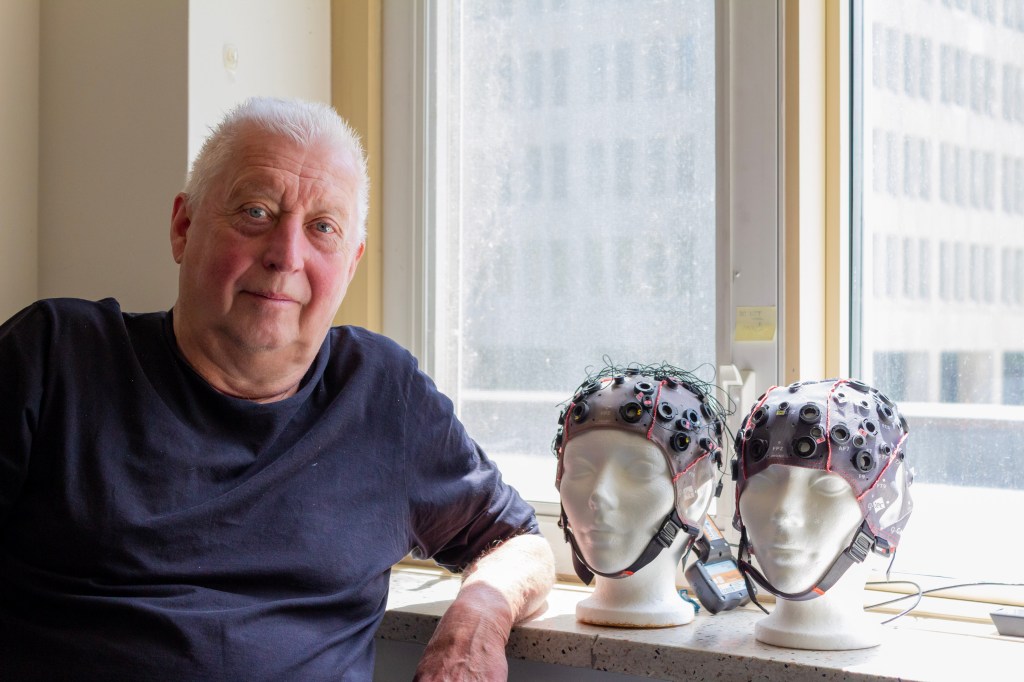
Professor of Music, Faculty of Music, Faculty of Medicine
Photo credit: Jino Lim
Even without specialized music training, humans are predisposed to move to music.1 Many of the brain’s motor areas for timing and coordination play critical roles in rhythm perception and production, including the basal ganglia, cerebellum, and premotor cortex.2 This is due to a common need for timing and prediction, as both music and movement require the brain to anticipate future events to stay on beat or coordinate actions smoothly. This shared neural circuitry reflects the strong connection between the auditory and motor systems, allowing auditory cues to guide and refine movement by stimulating activity in motor regions.
Dr. Michael Thaut, a professor of both music and medicine at the University of Toronto, has spent over three decades researching how to leverage the connection between rhythm and motor function to treat movement disorders and impairments.
For Dr. Thaut, understanding the relationship between music and movement was not a purely academic interest; as a “professional violinist in [his] first life,” he was intrigued by how musicians can synchronize intricate movements with precise auditory cues. His experiences inspired him to leverage the neural connection between rhythm and action to treat motor impairments. This question shaped Dr. Thaut’s research and led him to develop Neurologic Music Therapy (NMT), a system of neuroscience-based treatment interventions that employ music and rhythmic exercises to rehabilitate sensorimotor, language, and cognitive deficits.3
Motor impairment is a hallmark symptom of many disorders, including Parkinson’s disease (PD), stroke, and cerebral palsy. These conditions involve damage to or dysfunction of the brain’s movement systems, causing slow, inaccurate, and inconsistent execution of motor commands. Dr. Thaut describes this as “an optimization problem,” in which the brain is unable to turn neural signals into effective and timely movements.4
NMT techniques such as rhythmic auditory stimulation (RAS) seek to overcome this limitation by using a strong rhythmic beat to jump-start motor function.3 RAS relies on a phenomenon called auditory-motor entrainment, where the brain’s auditory system spontaneously synchronizes neuronal firing to a strong beat. Because the auditory system is heavily connected to the brain’s motor areas, motor signals synchronize to the beat, effectively “lock[ing] the motor system,” explains Dr. Thaut. The steady beat provides the motor system with a consistent movement cue and a predictable time constraint in which the movement must occur (i.e., before the next beat), helping the brain overcome timing and signaling deficits within the motor system. Auditory cueing is especially effective for cyclical movements like walking, where the beat cues each step. Patients with profound gait impairments from PD or stroke experience vast, immediate improvements in their walking when exposed to RAS, thanks to auditory-motor entrainment.5
Dr. Thaut’s team is now working to uncover the biochemical drivers of entrainment-related motor improvement. In a study published in Frontiers in Neuroscience, they examined dopamine uptake—a neurotransmitter critical to motor function—during a finger-tapping task with and without RAS.6 They found that dopamine uptake was reduced when participants were exposed to RAS compared to when they completed the task with no auditory support. This implies rhythmic input may act as a substitute for dopaminergic messaging, thereby reducing the amount of dopamine needed to complete the tapping task. Dr. Thaut believes this may explain why patients with PD—a condition characterized by degeneration of dopaminergic neurons, and subsequent dysregulation of dopamine, in critical motor areas of the brain—experience such immense benefits from RAS therapy. As Dr. Thaut explains, “the [facilitation] effect of rhythmic stimulation is very significant in enhancing the ability to exercise or recover physical function.”
Dr. Thaut is also a global leader in sonification research. In motor rehabilitation, sonification involves converting a patient’s movements into sound, allowing for real-time auditory feedback of the motor system. As a patient moves, specialized sensors can translate their motion into changes in pitch, volume, or tone. This immediate musical feedback drives neural activity and promotes new connections within the shared auditory-motor pathway, helping the brain to rapidly relearn or strengthen motor functions.
This concept is critical for an NMT technique developed by Dr. Thaut called Therapeutic Instrumental Music Performance (TIMP), where functional movements are paired with musical instruments to practice and strengthen motor abilitiy.3 In TIMP, instruments are strategically placed to help patients strengthen targeted movements; for example, a xylophone might be placed in front of a patient so they can practice reaching. When the movement is executed correctly, the patient creates sound with the instrument. Dr. Thaut has successfully utilized TIMP to improve motor function in patients with cerebral palsy, stroke, and PD, and his team is working to optimize the benefits of TIMP therapies.5
Beyond motor rehabilitation, sonification has been applied to improve exercise and sport performance. Dr. Thaut has consulted with sports teams (e.g., in rowing) to improve synchronicity and form.
Across the world, neurologic music therapy is practiced by over 3000 therapists, with neuroscience-based training becoming more common each year.3 Within Canada, RAS is even recommended by the Canadian Heart and Stroke Best Practices guidelines for gait rehabilitation;7 however, Dr. Thaut believes that the future of NMT lies in expanding its access. “The basic mechanisms are well established… I think one of the most interesting challenges is not so much new discoveries, [but rather] how do we get those interventions into different parts of the world, such as low- and middle-income countries.” By improving access to NMT knowledge and training, Dr. Thaut hopes that more people will be able to experience the incredible benefits of music-based motor rehabilitation.
References
- Thaut MH. Rhythm, music, and the brain: Scientific foundations and clinical applications. 1st ed. New York and London: Routledge; 2008.
- Grahn JA, Watson SL. Perspectives on rhythm processing in motor regions of the brain. Music Ther Perspect. 2013;31(1):25–30.
- Academy of Neurologic Music Therapy. What is neurologic music therapy [Internet]. Academy of Neurologic Music Therapy; 2026 [cited 2026 May 26]. Available from: https://nmtacademy.co/nmt-system-of-standardized-techniques/
- Thaut MH. The discovery of human auditory–motor entrainment and its role in the development of neurologic music therapy. Prog Brain Res. 2015;217:253-66.
- Braun Janzen T, Koshimori Y, Richard NM, et al. Rhythm and music-based interventions in motor rehabilitation: Current evidence and future perspectives. Front Hum Neurosci. 2021;15:789467.
- Koshimori Y, Strafella AP, Valli M et al.. Motor synchronization to rhythmic auditory stimulation (RAS) attenuates dopaminergic responses in ventral striatum in young healthy adults:[11C]-(+)-PHNO PET study. Front Neurosci. 2019;13:106.
- Canadian Heart&Stroke. Canadian stroke best practices [Internet]. Toronto: Canadian Heart&Stroke; 2026 [cited 2026 May 26]. Available from: https://www.strokebestpractices.ca/recommendations


You must be logged in to post a comment.