
By Rivka Zeng-van Klei
Graphic design by Kevin Trinh
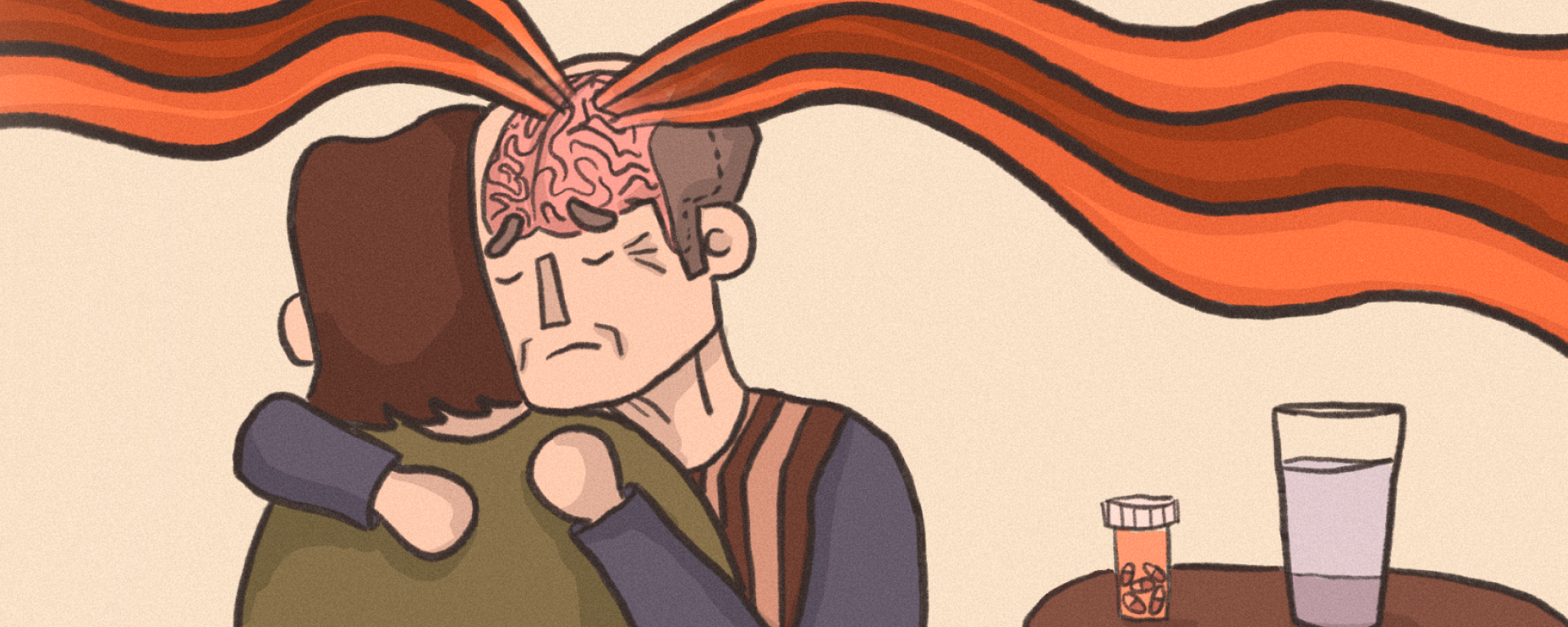
In Canada, depression affects 10-15% of adults aged 65 and older living in the community and 44% of those in residential care.1 Treating late-life depression (LLD) is especially challenging, since nearly half of LLD patients go on to develop treatment-resistant late-life depression (TRLLD), which is defined as a lack of response to two or more adequate trials of antidepressant treatment.2 TRLLD is often accompanied by cognitive impairment3 and up to a six-fold increase in risk of dementia,4 driving significant healthcare costs and underscoring the need for treatments that target both depression and cognitive decline in this population.

Scientist with the Brain Health Imaging Centre and the Krembil Center for Neuroinformatics (KCNI) at the Centre for Addiction and Mental Health, and Assistant Professor in the Department of Psychiatry at the University of Toronto
Photo credit: Dr. Peter Zhukovsky
Addressing this need is one of the central research aims of Dr. Peter Zhukovsky—scientist at the Centre for Addiction and Mental Health (CAMH) and assistant professor in the Department of Psychiatry at the University of Toronto (UofT). Dr. Zhukovsky began his academic journey at Cambridge University as a philosophy major, however he switched to a Natural Sciences and Psychology degree, being more drawn to quantitative approaches for understanding how the brain supports everyday human functioning. He then went on to pursue a Psychology PhD investigating the transdiagnostic mechanisms of substance use disorders. These early academic experiences fueled his interest in trying to understand the inner workings of the mind, an interest that motivates him in his research today.
Today, Dr. Zhukovsky’s research is focused on major depressive disorder (MDD), which he emphasizes is “one of the biggest challenges we have in psychiatry today.” His work leverages neuroimaging and blood biomarkers as well as machine learning to advance precision psychiatry goals in MDD. Of particular interest for Dr. Zhukovsky is understanding the heterogeneity within LLD symptom presentation, treatment response, and cognitive decline risk to be able to support this underrepresented population. Such heterogeneity often arises from an interplay of many factors spanning biology, psychology, and sociology. Increasing data availability, especially for neuroimaging and genetics has led to exciting discoveries in biomarkers predicting response to depression treatment. Dr. Zhukovsky is excited about the opportunities this has created to tackle such major challenges in depression research.
In a recently published study, Dr. Zhukovsky used machine learning models to investigate whether neuroimaging and clinical data could predict treatment response in patients with MDD.5 He found that the addition of neuroimaging data to the model improved the model’s performance. The model achieved a moderate 67% accuracy in out-of-trial performance, drawing some to question its clinical usefulness. Dr. Zhukovsky counters that this critique is precisely why the research matters: “If you really want to be negative about a certain research direction, you can probably find things that will discourage you… But if it is critical feedback, I always try and take it on board and make the most of it.” In recent years, the number of biomarker-guided trials has grown, and are increasingly showing promising response rates as more work is conducted in this area. By exposing potential limitations in previous studies, researchers can learn how to improve and build models with sufficient accuracy, generalizability, and clinical relevance.
Dr. Zhukovsky applied similar methods to find distinct brain patterns behind poorer cognitive function in people with TRLLD.6 He analyzed neuroimaging and cognitive data from OPTIMUM-NEURO—a neuroimaging sub-study of the Optimizing Outcomes of Treatment-Resistant Depression in Older Adults (OPTIMUM) trial. This study found two factors that might contribute to better response to antidepressant treatment: stronger baseline cognitive function and greater thickness in the rostral anterior cingulate cortex and postcentral gyrus—brain regions involved in emotion regulation and attention.
Building on these findings and his experience developing predictive treatment-response models for MDD in adults, Dr. Zhukovsky helped establish a model that predicts which antidepressant drug treatments a patient with TRLLD will respond to best. The development of this model was part of phase 1 of the Biotype-assigned Augmentation Approach in Resistant late-life Depression (BAARD) study, led by Dr. Daniel Felsky and Dr. Aristotle Voineskos in collaboration with Washington University and the University of Pittsburgh.7 The BAARD-tool developed in this study aims to assess which aspects of a patient’s clinical, cognitive, genetic, proteomic, and brain-imaging profile may determine which medication would be most effective. In phase 2 of the study, taking place over the next few years, 300 older adults with TRLLD will be recruited and split into two groups: one where the BAARD-tool decides the medication and one where the medication is randomly assigned. Remission rates, which describe whether an individual’s depression symptoms decrease between the two groups, will be compared. Studies like BAARD represent the next step in precision psychiatry research: turning years of research on individual differences in mental health disorders into something that could directly shape patient care.
Dr. Zhukovsky’s work has made crucial contributions to understanding what factors might influence cognitive decline and treatment-resistance among individuals with TRLLD. He attributes much of his success to collaboration; his postdoctoral fellowship mentor Dr. Diego Pizzagalli at Harvard Medical School, his colleagues at CAMH, and the students he works with. “We have to give credit where credit is due,” he says. “[UofT and IMS in particular] has really amazing students, I am very grateful for working with them. That is probably one of the most fun parts of the job.” Looking ahead, he remains optimistic about the field: “Precision medicine is a really exciting field… [it] has the power to change people’s lives and relieve the incredible burden on the healthcare system.” Dr. Zhukovsky hopes his research will help make precision medicine not just a research aim, but a reality. For older adults, this means that those who have depression do not have to try endless trials of treatments, but get the treatment that works for them quicker, so that they can enjoy more years of healthy, independent living.
References
- Canada E and SD. Report on the Social Isolation of Seniors [Internet]. 2016 [cited 2026 Sep 1]. Available from: https://www.canada.ca/en/national-seniors-council/programs/publications-reports/2014/social-isolation-seniors/page05.html
- Lenze EJ, Sheffrin M, Driscoll HC, et al. Incomplete response in late-life depression: getting to remission. Dialogues Clin Neurosci. 2008 Dec;10(4):419–30. doi:10.31887/DCNS.2008.10.4/jlenze PubMed PMID: 19170399; PubMed Central PMCID: PMC3181898.
- Butters MA, Whyte EM, Nebes RD, et al. The Nature and Determinants of Neuropsychological Functioning in Late-LifeDepression. Arch Gen Psychiatry. 2004 Jun 1;61(6):587–95. doi:10.1001/archpsyc.61.6.587
- Diniz BS, Butters MA, Albert SM, et al. Late-life depression and risk of vascular dementia and Alzheimer’s disease: systematic review and meta-analysis of community-based cohort studies. Br J Psychiatry. 2013 May;202(5):329–35. doi:10.1192/bjp.bp.112.118307 PubMed PMID: 23637108; PubMed Central PMCID: PMC3640214.
- Zhukovsky P, Trivedi MH, Weissman M, et al. Generalizability of Treatment Outcome Prediction Across Antidepressant Treatment Trials in Depression. JAMA Netw Open. 2025 Mar 20;8(3):e251310. doi:10.1001/jamanetworkopen.2025.1310
- Zhukovsky P, Butters MA, Lavretsky H, et al. Brain-cognition relationships and treatment outcome in treatment-resistant late-life depression. Nat Commun. 2026 Aug 29. doi:10.1038/s41467-026-76842-4
- RePORT ⟩ RePORTER [Internet]. [cited 2026 Sep 2]. Available from: https://reporter.nih.gov/project-details/10954667#details


You must be logged in to post a comment.