

By Kareena Thakur
Graphic design by Sarah Kung
There are certain people in our lives who endure the hardest parts of life, so that we do not have to. Through everything they build, and everything they refuse to give up, we realize they leave something of themselves within us.
For Institute of Medical Science (IMS) alumna Suraiya Mangra, the beginning of her story belongs to her great-grandmother: “the matriarch” of her family who immigrated from Trinidad to Canada without knowing how to read or write in English. She built a home and a life for her family through many difficulties, making her challenges with dementia even more disheartening. In the following months, Suraiya often wondered “what causes dementia?” and “what makes people more vulnerable?”, prompting her to explore this further.
These questions sparked an interest to volunteer at the Markhaven Home for Seniors, specializing in Alzheimer’s disease (AD) and dementia care. She found the opportunity to be rewarding, particularly to see the gratitude on residents’ faces as she spent time with them. At the same time, the facility’s large volume of patients showed her the extent of additional support needed in the field of geriatric care. It so happens that these preliminary experiences would eventually lead to a graduate career spent trying to understand, and ultimately improve, what happens to the brain as it ages.
Suraiya was accepted to study psychology at the University of Toronto Scarborough (UTSC). However, in her final year of high school, personal difficulties prevented her from starting undergraduate studies. She decided instead to pursue an alternative path of completing a two-year transfer program at Seneca College before returning to UTSC.
At UTSC, Suraiya became involved in research through the Youthdale Child and Adolescent Sleep Centre, a research clinic run by Dr. Colin Shapiro. The work included conducting neuropsychological assessments in paediatric patients and nudged her toward the specialized field of neuropsychology. By the end of her undergraduate studies, this direction became more intentional and led her to the Princess Margaret Cancer Centre where she secured a position as a neurocognitive tester in the brain metastases clinic. Ultimately, she found the volunteer work was limited due to patient-facing restrictions during the COVID-19 pandemic and she wanted to return to the senior population that had initiated her passion for this field.
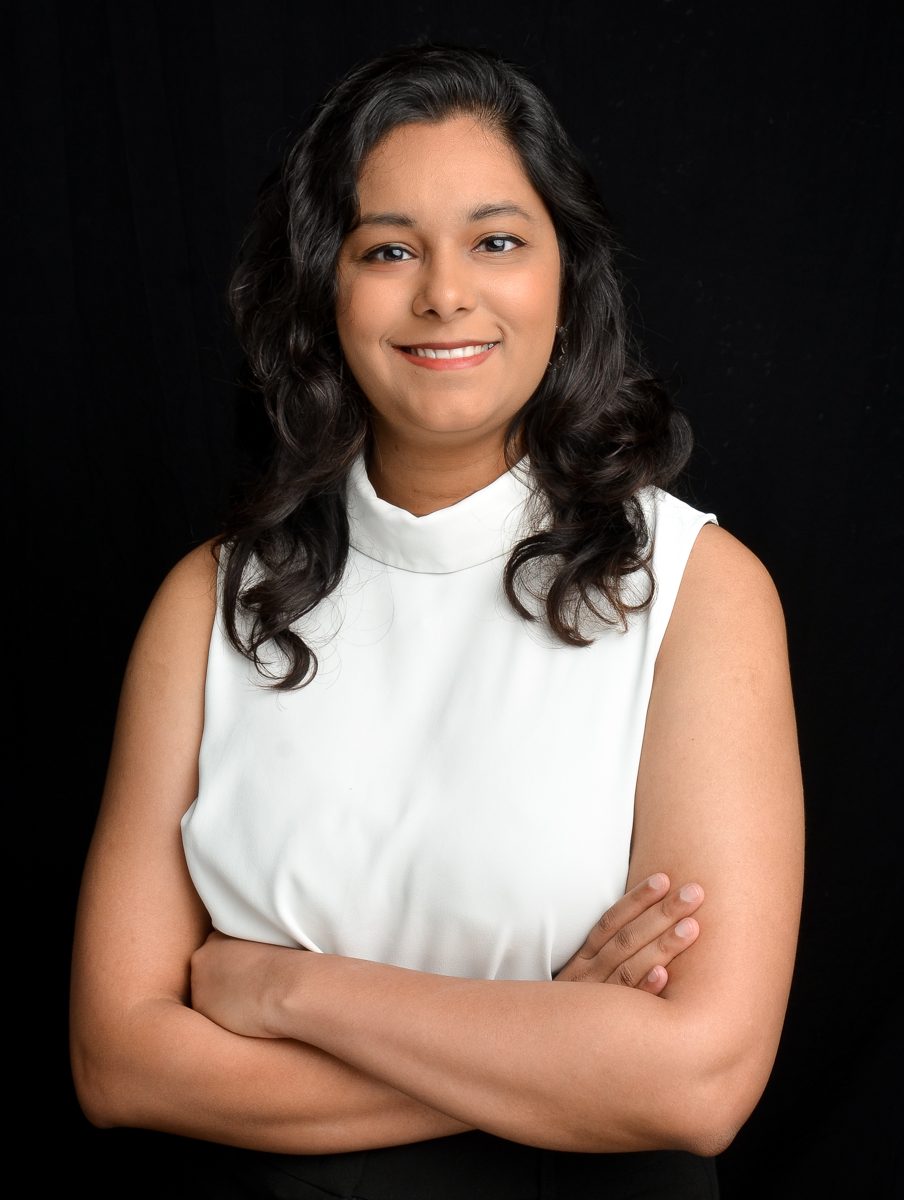
IMS Alumna and Global Trial Associate at Johnson & Johnson
Photo credit: Suraiya Mangra
This brought her to Toronto Western Hospital, where she joined as a research coordinator in the neurosurgery department under the supervision of Dr. Andres Lozano, the most cited neurosurgeon in the world. There she worked on clinical trials in neurodegenerative disease including managing concurrent Phase I and II trials: a stem cell study for individuals living with Parkinson’s disease (PD) and a deep brain stimulation (DBS) trial for individuals living with AD. Her time in the department allowed her to witness extraordinary moments such as being present in the operating room while surgeons placed electrodes into a conscious patient’s brain. Suraiya recalls one of the most worthwhile experiences was travelling to Nova Scotia to visit a participant in the DBS trial for treatment of AD—an assignment, she says, that research coordinators don’t typically receive. Overall, this was a rewarding experience which allowed her to understand key aspects about the field and clinical pipeline.
Suraiya’s fascination with this work led her to continue working with her supervisor as a master’s (MSc) student at IMS. Her thesis examined the effects of subthalamic nucleus (STN) DBS on hippocampal volume in individuals with PD. Specifically, she compared hippocampal volume changes in patients who received STN DBS to two PD cohorts without DBS. Her findings showed that hippocampi atrophied at similar rates across all groups, comparable to normal aging. This provided evidence against the longstanding belief that STN DBS causes significant hippocampal volume loss, a theory that has been used to explain poorer cognition following DBS surgery. Together, these findings challenged a common assumption about STN DBS and helped Suraiya see how clinical research can clarify questions that directly affect patient care.
Outside of research, Suraiya served as Editor-in-Chief of the IMS Magazine, working alongside IMS students Kristen Ashworth and Kyla Demkiv. She credits both Dr. Lozano and Dr. Jürgen Germann, Scientist at the Krembil Research Institute, as instrumental to her graduate experience. They significantly guided her writing, as well as encouraged her to aim beyond the completion of her MSc and seek additional opportunities to be involved. Since graduating, she has served as a panelist for IMS MedDash, speaking to high school students about paths within science that are not linear. Suraiya has become a pillar of the community, giving back and providing advice to those exploring potential career avenues.
Following her graduate degree, Suraiya sought to determine potential career options. She had experienced isolation in academic research stemming from being alone on her project and she missed being part of a larger research team. On top of this, a PhD seemed like a distant horizon. However, as a research coordinator, she sometimes watched patients struggle with certain protocol requirements and had no effective channel to bring that feedback to decision-makers. Thus, Suraiya desired to be in the room where those decisions were being made.
These factors led Suraiya to pursue an industry role after completing her MSc. She credits Dr. Pamela Plant and Dr. Michelle Dubinsky’s Medical Science Liaison course as foundational to understanding what industry looks like from the inside. Suraiya is now a Global Trial Associate at Johnson & Johnson—the first and only person in Canada currently in this position. The role is a one-year rotational leadership program focused on three positions in clinical trial operations: clinical trial assistant, site manager, and local trial manager. In these roles, she is learning to become a primary contact for clinical research sites, hold country-level oversight over studies, and foster international collaborations. After completing the program, she will be moving into site management permanently and be able to have a key role in trial oversight.
She recognizes that much of her success and personal development over the years is dedicated to her parents, noting that her move into clinical operations is also a full-circle moment. For years, Suraiya watched her mother, who has worked in clinical research as a site manager, leave for site visits. “Now I’m going to be the one travelling to interesting places and supporting sites the way I was once supported by study sponsors during my coordinator days,” she says in excitement for what is to come.
When asked what she would tell IMS students navigating their own obstacles, she stresses: “Don’t let the fear of rejection rule you, you’d be amazed at what you could accomplish.” She emphasizes that there are other ways beyond the traditional route to succeed and it is simply a matter of having the resourcefulness to find opportunities, and more importantly, the bravery to use them.
As she wraps up her time in this position and looks towards the future, she reflects on her great-grandmother who arrived in a new country and built something that lasted generations. She states: “I hope I’ve become even a quarter of the woman she was. She had such a challenging life, even before she came here, and she still managed to build something for all of us. She still serves as such an inspiration to me.” Suraiya, who has known rejection and the loneliness of a path that is not conventional, is now the first in the country to hold her current position, blazing the trail for more people to walk. She is indeed like her great-grandmother in more ways than one.


You must be logged in to post a comment.